Download
1 / 19
200 likes | 326 Vues
This overview of nuclear chemistry defines key concepts such as nuclides, nuclear reactions, and transmutation. It explores radioactive decay, half-life, and the various types of nuclear radiation, including alpha, beta, and gamma emissions. The principles governing nuclear fission and fusion are discussed, highlighting their benefits and drawbacks. Additionally, the role of nuclear power plants and challenges related to safety and waste disposal are examined. Understanding these foundational elements is crucial for anyone studying nuclear chemistry and its applications.

E N D
Nuclear Chemistry Day One
Nuclear Chemistry • In nuclear chemistry, an atom is referred to as a nuclide and is identified by the number of protons and neutrons in the nucleus. • Nuclear reaction – a reaction that affects the nucleus of an atom. • Transmutation – a change in the identity of a nucleus as a result of a change in the number of protons.
Radioactive Decay • Radioactive decay – spontaneous disintegration of a nucleus into a slightly lighter and more stable nucleus, accompanied by emission of particles, electromagnetic radiation, or both. • Energy & matter released in nuclear radiation & is damaging. • During radioactive decay, radiation exits the nucleus & interacts with matter nearby.
Half Life • Half-Life – the time it takes for half a radioactive element to undergo radioactive decay. • The half-life of radioactive elements can be used to date rocks, fossils, etc. • Each radioactive isotope has a characteristic half-life. • Equation: Initial mass (½ )(# of ½ lives) = final mass
Trivia Time! The death of Jim Henson Rowlf the Dog has not spoken on the Muppets since which event occurred?
Types of Nuclear Radiation • 5 types of nuclear radiation: • alpha particles () • beta particles () • gamma rays () • electron capture of an inner orbital electron, • positron emission to form neutrons • Nuclear Decay — when an unstable nucleus emits alpha or beta particles, the number of protons & neutrons may change. • This process can be written in a nuclear equation/nuclear reaction. • Transmutation occurs. (Nucleus changes identity.)
84 82 2 Alpha Emission • Alpha Particle – two protons and two neutrons bound together emitted from the nucleus during radioactive decay. • The reaction produces a helium nuclei. • The atomic number decreases by two, the mass number decreases by four. • Example: 210Po 206Pb + 4He
6 7 -1 Beta Emission • Beta Particle – an electron emitted from the nucleus as a beta particle – as a neutron is converted into a proton • The atomic number increases by one, the mass number stays the same. 14C 14N + 0
7 15 7 15 0 0 Gamma Emission • Gamma Particle – high energy electromagnetic waves emitted from a nucleus as it changes from an excited state to a ground energy state. • Gamma emission usually occurs immediately following other types of decay. • Of the three types of nuclear radiation, gamma rays have the greatestpenetrating power. • Example: N N + γ
Don’t Forget • Remember: • Mass #’s add up to be the same on each side of the arrow. • Atomic #’s add up to be the same on each side of the arrow.
43K ______ +-10e 210Po 4He + ____ ____ 210Bi +4α 60Co ______ +-10β 253Es + 4He 1n + ? 43Ca 206Pb 214At 60Ni 256Md Balance the Nuclear Reactions
Decay Series 218Po A series of nuclear emissions can occur until a stable element is formed. In this example, two alpha emissions and two beta emissions occur. 222Rn 4He + ______ ______ _____ + 4He ____ _____ + -10β ____ _____ + -10β 214Pb 218Po 214Pb 214Bi 214Bi 214Po
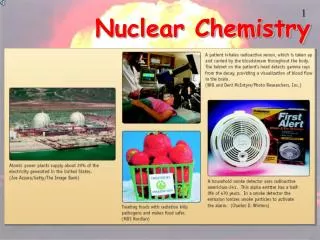
Nuclear Power Plants • Nuclear power plants use heat from nuclear reactors to produce electrical energy. • They have five main components: • Shielding • Fuel • Control rods • Moderator • Coolant • Shielding – radiation-absorbing material that is used to decrease exposure to radiation from nuclear reactors. • Current Problems with nuclear power: environmental requirements, safety of operation, construction costs, and storage and disposal of spent fuel and radioactive wastes.
Nuclear Fission • Nuclear Fission – an atom breaks up into smaller atoms. • energy is released. E=mc2 or E= m ( 9 x 10¹⁶ ) • Fission is the primary system powering nuclear reactors, nuclear missiles, and nuclear powered submarines and air craft carriers.
Benefits and Drawback of Fission • Benefits • Fairly easy to start and control reaction • Drawbacks • Harmful waste products, need protection and storage for indefinite amount of time
Nuclear Fusion • Nuclear fusion – atoms join together to make 1 atom. (opposite of fission) • Energy is released after the reaction but lots of energy is needed to start the reaction – atoms need to gain enough energy to combine when they collide, not repel. • Very high temperatures and pressures are used to combine light atoms, such as hydrogen, to make heavier atoms, like helium. • Ex. The Sun: Overall 4 hydrogen atoms make a helium atom • More mass is converted to energy than fission so it is a more powerful reaction
Benefits and Drawbacks of Fusion • Benefits • No harmful waste products • Fusion reactants (Hydrogen) are plentiful • Drawbacks • SO MUCH ENERGY! Creating and maintaining a fusion reaction is more complex and expensive than performing fission. • If a pinhead-size piece of the Sun were placed on Earth, one would have to stand as far as 145 kilometers (90 miles) away to be safe.