
Advanced Weed Management Techniques and Laws
E N D
Presentation Transcript
Weed Control Plant Science 280 Mr. Gomes
Methods of Weed Management • There are Four Methods of Weed Management • Prevention • Control • Eradication • Management
Prevention • Defined as: Stopping weeds from contaminating an area • The most difficult part of weed management is prevention • Takes time and attention to detail • Very hard to qualify • An ounce of prevention is worth a pound of cure
Prevention Measures • Not importing weeds or weed seeds in animal feed (Clean Hay) • Using on clean crop weed seed • Cleaning equipment between fields and especially between farms • Preventing Seed production especially by new weeds • Preventing vegetative spread of perennials • Scouting for new weeds – finding them before becoming a problem • Small patch treatment to prevent patch expansion • Education about weeds
Control • Easy to do and usually effective • Easy to qualify • Techniques used to limit weed infestations and minimize infestations • Balance between cost of control and crop yield loss • Unfortunately this occurs after a problem already exists • Can be selected to meet short term economic or cultural planning goals
Eradication • The complete elimination of all live weeds, vegetative reproductive parts, and weed seed • 100% elimination = complete control • Sounds easy, but virtually impossible • Rarely successful • Requires long term thinking and planning • $$$$$$$$
Management • Combination of Prevention, Control, and Eradication • Driven by cropping history, growers management objectives, available technology, financial resources • In most cases, maintenance of a weed pop at low levels is the most achievable goal
Federal Seed Act • First step to good management in many cases is planting clean and certified seed • First enacted in 1939 by the USDA • Regulates the sales and transport of seed in foreign and interstate commerce • Labels are required to detail information including germination, variety, noxious weed %, etc.
Weed Laws • About 1/3 of US states do not have a limitation on weed seed in crop seed • In those that do, they usually range from 1-4% or less. • Most state laws exempt seed sold by a grower • There are currently 1553 species of plants that are identified as noxious weeds in the US • Federal Plant Protection Act
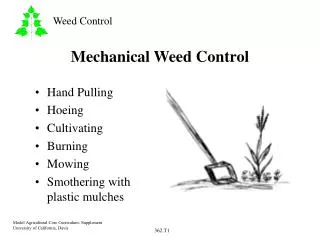
Nonchemical Methods of Weed Management • Mechanical Control • Nonmechanical • Cultural Weed Management • Companion Cropping and Cover Crops • Crop Rotation • Fertility Manipulation
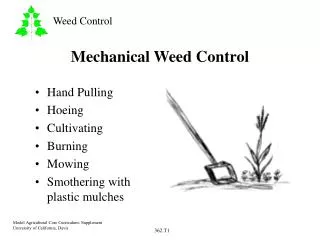
Mechanical Control • Still the primary weed control method outside of the US • Requires several key factors • Nearly always requires several trips through the field • Precise timing • Favorable weather • Much more planning is needed than even chemical control
Mechanical Control: Tillage • Easily the first thought in mechanical control for most • Usually the most economical • Utilizes an implement to disturb, cultivate, and mix soil • Controls weeds by; • Burial • Separating shoots from roots • Stimulating germ of dormant seeds and buds • Desiccating shoots • Exhausting carb reserves for perennials
Tillage Cont. • Added benefits include • Aeration • Seedbed prep • Trash incorporation • Intrarow cultivation • Break up soil compaction • Reduction in crusting • Increase in water penetration • Disadvantages • Aid in soil compaction • Exposure to erosion • Moisture loss • Stimulation of further weed growth
Tillage Methods • Primary – 6” to 24” • Moldboard • Chisel plow • Secondary – less than 6” • Double disk • Harrow • Torsion and finger weeder • Cultivator • Rotary hoes • spring tooth • rototiller
Mechanical Control: Mowing • Can be especially effective on perennials • Depletion of root reserves • Ideally utilized before viable seeds are produced • A useful tool but rarely accomplishes much control because of timing window
Ecological Control • Flooding/Draining • Wet to Dry, Dry to Wet (3-8 week period) • Barnyardgrass and junglerice • Salt Water • Can be used as two distinct methods, flooding and as a herbicide • Chaining • Mostly used in rangelands to destroy invasive species • Anchor chain dragged between bulldozers • Sagebrush and rabbitbrush
New Techniques • Harrington Seed Destructor (Ray Harrington) • Separately powered grinder to grind weed and other mature seeds • Reduced ryegrass by 95% • Disperses organic material back to soil • Air Propelled Abrasives (Frank Forcella 2009) • Abrasive grit from corn cobs • Microsecond blast • Affective on lambsquarters but minimal affect on corn