
Understanding C Programming Concepts through Practical Examples
E N D
Presentation Transcript
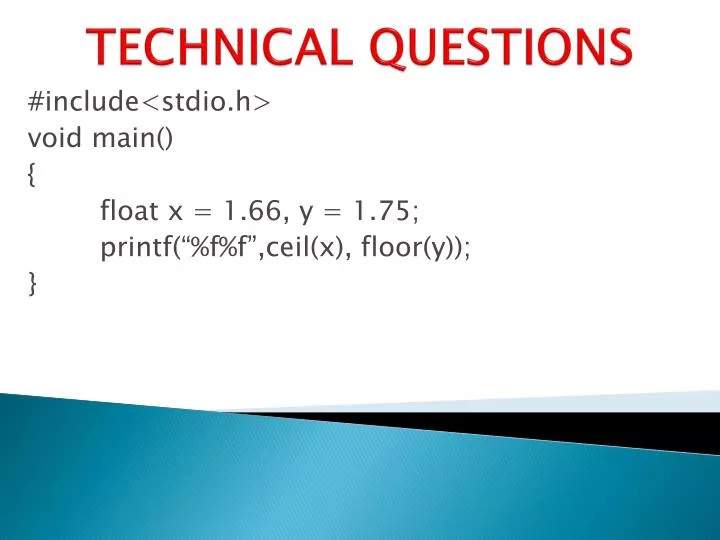
TECHNICAL QUESTIONS #include<stdio.h> void main() { float x = 1.66, y = 1.75; printf(“%f%f”,ceil(x), floor(y)); }
TECHNICAL QUESTIONS #include<stdio.h> void main() { int x = 10, y =20; if(!(!x) && x) printf(“x = %d”,x); else printf(“y = %d“,y); }
TECHNICAL QUESTIONS #include<stdio.h> void main() { int a = 500, b=100,c; if(!a >= 400) b = 300; c = 200; printf(“b = %d c = %d”,b,c); }
TECHNICAL QUESTIONS #include<stdio.h> void main() { int a = 10,b; a >= 5 ?b=100 :b=200; printf(“%d”,b); }
TECHNICAL QUESTIONS Which of the following cannot be checked in a switch - case statement? Character Integer Float
TECHNICAL QUESTIONS Which of the following are unary operators in C? ! sizeof ~ && =
TECHNICAL QUESTIONS #include<stdio.h> void main() { static int a[20]; int i = 0; a[i] = i++; printf(“%d%d%d”,a[0],a[1],i); }
TECHNICAL QUESTIONS #include<stdio.h> void main() { int I = 3; i = i++; printf(“%d”,i); }
TECHNICAL QUESTIONS #include<stdio.h> void main() { int x = 4,y,z; y = --x; z = x--; printf(“%d%d%d”,x,y,z); }
TECHNICAL QUESTIONS #include<stdio.h> void main() { int x = 55; printf(“%d%d%d”,x<=55,x=40,x>=10); }
TECHNICAL QUESTIONS #include<stdio.h> #define SQR(x) (x * x) void main() { int a, b =3; a = SQR(b+2); printf(“%d”,a); }
TECHNICAL QUESTIONS #include<stdio.h> void main() { int arr[1] = {10}; printf(“%d”, 0[arr]); }
TECHNICAL QUESTIONS If the array begins at address 1200 in memory, what will be the output of the program? #include<stdio.h> void main() { int a[] = {1,2,3,4,5}; printf(“%u%u%u”,arr,&arr[0],&arr); }
TECHNICAL QUESTIONS #include<stdio.h> void main() { float a[] = {1.2,2.4,3.5,4.5}; printf(“%d”, sizeof(a) / sizeof(a[0])); }
TECHNICAL QUESTIONS #include<stdio.h> void main() { printf(“%c”, “abcdefgh”[4]); }
TECHNICAL QUESTIONS #include<stdio.h> void main() { printf(5 + “Fascimile\n”) } o/p : mile
TECHNICAL QUESTIONS #include<stdio.h> void main() { int I; printf(“%d”, scanf(“%d”,&i)); }
TECHNICAL QUESTIONS #include<stdio.h> void main() { char p[] = “%d\n”; p[1] = ‘c’; printf(p,65); }
TECHNICAL QUESTIONS #include<stdio.h> void main() { char str[10] = “Angel”; str[6] = ‘d’; printf(“%s”,str); } o/p : Angel
TECHNICAL QUESTIONS #include<stdio.h> void main() { char str[] = “Sales\0man\0”; printf(“%s”,str); } o/p : Sales






![[PDF] ISTQB Technical Test Analyst (CTAL-TTA) Certification | Sample Questions](https://cdn4.slideserve.com/8467106/istqb-technical-test-analyst-ctal-dt.jpg)