The Evolution of Democracy and Politics in the United Kingdom
190 likes | 367 Vues
This text provides an insightful overview of the political evolution and democratization process in the United Kingdom. From the landmark Magna Carta in 1215 to the establishment of the welfare state post-World War II, it highlights key reforms and events that shaped modern British democracy. It also discusses the significant shifts under various prime ministers, including Margaret Thatcher and Tony Blair, tracing the impact of neoliberal policies and austerity measures on the economy. The article concludes by examining current issues like university fees and local government devolution.


The Evolution of Democracy and Politics in the United Kingdom
E N D
Presentation Transcript
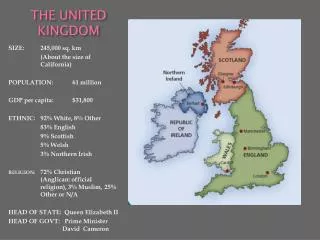
THE UNITED KINGDOM SIZE: 245,000 sq. km (About the size of California) POPULATION: 61 million GDP per capita: $31,800 ETHNIC: 92% White, 8% Other 83% English 9% Scottish 5% Welsh 3% Northern Irish RELIGION: 72% Christian (Anglican: official religion), 3% Muslim, 25% Other or N/A HEAD OF STATE: Queen Elizabeth II HEAD OF GOVT: Prime Minister David Cameron
Gradualism in British Political Evolution • Democratization occurred over a very long period of time. • Why is this important? • Compared with other states, the time span for democratic evolution is immense. • Allows for a stable transition to democracy.
Growth of Parliamentary Power 1215: Magna Carta • No absolute monarch • Consent of nobility to tax and spend. 1660 Restoration • Ended Civil War • Monarchy restored • Expanded role of Parliament
Growth of Parliamentary Power 1688 Glorious Revolution • King would be Anglican. • Parliament Supreme 1911 Reform of Lords • House of Lords power is stripped. • House of Commons is supreme.
Democratization 1832 Great Reform Act • Expanded the male vote 1867 Reform Act • All male householders could vote.
Democratization 1918 Representation of the People Act • All men and women over 30 could vote. 1928 Equal Franchise Act • All women can vote.
Collectivist Consensus (1945-1979) • Consensus between parties on major policies. • Greater economic equality. • Full employment. • Government control of major industries. • Creation of a WELFARE STATE. • State provides a wide variety of social services. • MIXED ECONOMY • Government nationalizes major industry. • Continues to allow other principles of capitalism • (i.e., private property)
Beveridge Report (1942) • Social Insurance Program for all • Health care • Unemployment insurance • Pensions • National Health Service (NHS), 1948
End of Consensus: Economic Crisis of 1970s • Inflation • Stagnating Economy • Declining Industrial Competitiveness • OPEC quadrupled oil prices • Government mismanagement of industry • Strikes by laborers in major industries
Margaret Thatcher “The Iron Lady” • End of consensus • PRIVATIZATION • Selling state-owned companies • NEOLIBERAL • Revival of liberal ideas • Lower taxes, govt. regulation, & welfare spending. • Protect property rights. Prime Minister: 1979-1990 (Conservative Party)
Thatcher’s Record • Privatization: • 25 state-owned sold • Unemployment: • 1979: 5% • 1987: 10% • 1990: 5.5% • Inflation: • 1980: 21% • 1986 2.5 % • Economic Growth • 1.9% in 1980s • Taxes • Lowered Income Tax • Raised Consumption Tax (Value-Added Tax) 8% to 15%
Tony Blair“The Third Way” Prime Minister: 1997-2007 (Labour Party) • “New Labour Party” • Combine socialism and market economy. • Kept Thatcher’s major privatization reforms. • Increased welfare assistance. • Welfare-to-work • Pensions • NHS • Education
David Cameron British Economic Woes • Blair’s increase in welfare assistance. • 2008 Global Recession and bailout. • UK debt as % of GDP 2010: 76.1% (U.S. 2010: 62.3%) Prime Minister: 2010-? (Conservative Party)
UK’s Austerity Measures CUTS • Department budgets by 19%. • Public jobs (1/2 million). • Police spending. • Grants to local govt. • Royal household • Unemployment • Retirement benefits • Raising pension age • Raising VAT • 17.5% to 20%
Cameron’s “Big Society” • Volunteerism • Empowering individuals and local communities. Power shift Whitehall British people Concern • Funds for volunteer agencies and local communities. • DEVOLUTION: • Delegating decision-making to local public bodies.
University Fees KEY FACTS • Fees in England to rise to a maximum of £9,000 a year • Universities charging more than £6,000 will have to meet requirements designed to help poorer students • Graduates will begin paying back loans covering their fees once they are earning at least £21,000 a year • They will pay back 9% of their earnings above this level • No tuition fees in Scotland, but universities there are calling for 'graduate contributions' • Fees in Wales are to rise in line with those in England - but Welsh students will be subsidised wherever they study in the UK so will pay no more than the current fees of £3,290 a year • A review of the system in Northern Ireland is under way