Lower Stratospheric Temperature Trends
110 likes | 241 Vues
This undergraduate project presentation from the University of Reading investigates lower stratospheric temperature trends, emphasizing their significance in understanding climate change and ozone depletion. We analyze quantitative results of global temperature trends and their impacts on climate, while comparing data from the Northern and Southern Hemispheres. Using MSU data, we present a global cooling trend of 0.52 K per decade and discuss contributors like volcanic eruptions and Polar Stratospheric Clouds (PSCs). The results reveal significant variability and uncertainties that shape our understanding of these trends and their implications for future research.


Lower Stratospheric Temperature Trends
E N D
Presentation Transcript
Kay SheltonUniversity of Reading, UK Lower Stratospheric Temperature Trends Undergraduate Project presentation
Background • Why are we interested the lower stratosphere? • Ozone depletion • Contributory factors • Self-perpetuating cycle of ozone destruction and temperature • Role of Polar Stratospheric Clouds (PSCs)
Objectives • Quantitative result of trend in global temperature, and impact on climate • Comparison between Northern and Southern Hemispheres
Methodology • MSU data • www.atmos.uah.edu/essc/msu • Monthly-mean temperature anomaly • Daily, zonal temperatures • Temperature integral
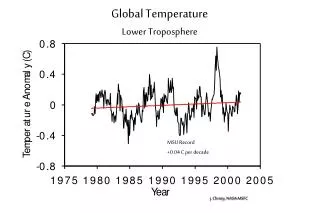
Results I – Monthly-mean • Global cooling trend of 0.52 K /decade • NH and SH contribution to global trend • Volcanic eruptions
Results II – Daily, zonal • Northern / Southern hemisphere comparison • Northern hemisphere variability and sudden stratospheric warmings • Magnitude of temperature anomaly • Temperature integral
Results II (cont.) • Latitudinal variation in trend • Changing view of temperature trends
Results II (cont.) • Uncertainty associated with using a fixed PSC threshold temperature • NH / SH comparison
Uncertainties and Limitations • MSU senses over broad altitude band • Mean layer signal • Satellite drift • Tropical latitudes • Assumption of PSC formation • Significance of the trends
Conclusions and Future Work • Global cooling trend • Cooling trend more severe in polar regions • Contrast between NH and SH • Comparison of trend results with those from other data sets (e.g. radiosonde) • Validation of PSC formation from observations • Remove effects of oscillations from trend • QBO, ENSO, Sun-spot cycle