1 / 1

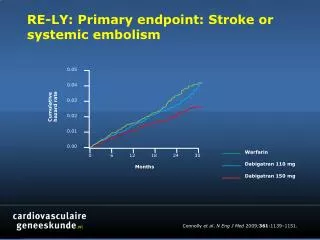
Comparative Cumulative Hazard Rates of Warfarin vs. Dabigatran for Stroke Prevention

This analysis investigates the cumulative hazard rates associated with Warfarin and two doses of Dabigatran (110 mg and 150 mg) in the context of stroke or systemic embolism prevention. The primary endpoint focuses on the efficacy of these anticoagulants over a period of 30 months, referencing the landmark RE-LY trial as conducted by Connolly et al. The findings aim to provide insights into the safety and effectiveness of both treatment options in patients at risk for thromboembolic events.

yul
Télécharger la présentation

Comparative Cumulative Hazard Rates of Warfarin vs. Dabigatran for Stroke Prevention

An Image/Link below is provided (as is) to download presentation Download Policy: Content on the Website is provided to you AS IS for your information and personal use and may not be sold / licensed / shared on other websites without getting consent from its author. Content is provided to you AS IS for your information and personal use only. Download presentation by click this link. While downloading, if for some reason you are not able to download a presentation, the publisher may have deleted the file from their server. During download, if you can't get a presentation, the file might be deleted by the publisher.

E N D

Presentation Transcript


  1. 0.05 0.04 Cumulative hazard rate 0.03 0.02 0.01 0.00 Warfarin 0 6 12 18 24 30 Dabigatran 110 mg Months Dabigatran 150 mg RE-LY: Primary endpoint: Stroke or systemic embolism Connolly et al. N Eng J Med 2009;361:1139–1151.

More Related