Download
1 / 9
90 likes | 207 Vues
This lesson focuses on finding the area of composite figures, measuring volume as filling, and surface area as wrapping for objects. Students will explore various types of boxes, including cubes, while discussing rules and special characteristics of these shapes. Through group activities, students will create nets for cubes and rectangular boxes, enhancing their understanding of geometric principles. They will complete problems on page 10 (#1-6) to practice their skills in calculating area and understanding the features of 3D shapes.

E N D
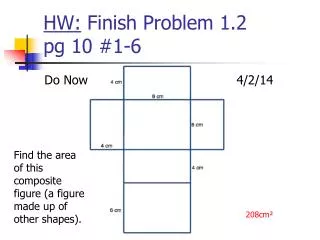
HW: Finish Problem 1.2pg 10 #1-6 Do Now 4/2/14 Find the area of this composite figure (a figure made up of other shapes). 208cm²
Unit Goal • Understand volume as a measure of filling an object and surface area as a measure of wrapping an object.
Intro to 3D Measurement • Filling & Wrapping • Pg 2-3 • What types of things come in boxes? • What constraints (rules) might companies have about the boxes? • Are there any special types of boxes?
Cubes • What does a cube look like? • What features of a cube can we count? • We call the corners vertices. How many vertices are there? • How many edges does a cube have? • We call the sides faces. How many faces does a cube have? • What’s special about the faces?
Investigation 1 – Building Boxes • Page 5
Problem 1.1 • Work with your group to create as many nets as you can that will form closed cubes. • Use grid paper and scissors to cut them out, fold them, and see if they work! • Make a sketch in your notebook of each net that forms a cube.
Problem 1.1 • How many nets did we find? • Cube Nets • What is the total area needed to cover a unit cube?
Problem 1.2 • Using the same ideas you had when constructing nets for cubes, try making them for rectangular boxes by completing Problem 1.2 • Work with your group • Finish for Homework (along with pg 10 #1-6)
Homework • Finish Problem 1.2 • Pg 10 #1-6