Understanding Correlation and Regression: Key Concepts and Formulas
This comprehensive overview delves into correlation and regression, essential statistical techniques for analyzing the relationships between continuous variables. Explore critical concepts, including definitions, deviation scores, hypothesis tests, and the coefficients of regression (intercept and slope). Learn how to measure the strength and direction of relationships using Pearson's r and the significance of associations. Understand the linear and non-linear forms of regression and their applications in predicting outcomes. Ideal for students and professionals seeking to enhance their statistical analysis skills.

Understanding Correlation and Regression: Key Concepts and Formulas
E N D
Presentation Transcript
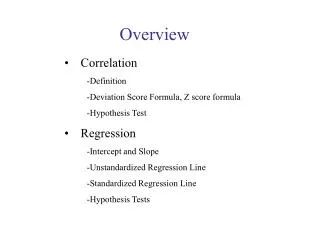
Overview • Correlation • -Definition • -Deviation Score Formula, Z score formula • -Hypothesis Test • Regression • Intercept and Slope • Unstandardized Regression Line • Standardized Regression Line • Hypothesis Tests
3 characteristics of a relationship • Direction • Positive(+) • Negative (-) • Degree of association • Between –1 and 1 • Absolute values signify strength • Form • Linear • Non-linear
Direction Positive Negative • Large values of X = large values of Y, • Small values of X = small values of Y. • - e.g. IQ and SAT • Large values of X = small values of Y • Small values of X = large values of Y • -e.g. SPEED and ACCURACY
Degree of association Strong(tight cloud) Weak(diffuse cloud)
Form Linear Non- linear
What is the best fitting straight line? Regression Equation: Y = a + bX How closely are the points clustered around the line? Pearson’s R
Dataset Obs X Y A 1 1 B 1 3 C 3 2 D 4 5 E 6 4 F 7 5 Correlation - Definition Correlation: a statistical technique that measures and describes the degree of linear relationship between two variables Scatterplot Y X
Pearson’s r A value ranging from -1.00 to 1.00 indicating the strength and direction of the linear relationship. Absolute value indicates strength +/- indicates direction
Cross-Product = The Logic of Correlation MEAN of X MEAN of Y For a strong positive association, the cross-products will mostly be positive
The Logic of Correlation MEAN of X MEAN of Y For a strong negative association, the cross-products will mostly be negative Cross-Product =
The Logic of Correlation MEAN of X MEAN of Y For a weak association, the cross-products will be mixed Cross-Product =
Deviation score formula SP (sum of products) = ∑ (X – X)(Y – Y) Pearson’s r
Deviation Score Formula = .99
Deviation score formula SP (sum of products) = ∑ (X – X)(Y – Y) Pearson’s r For a strong positive association, the SP will be a big positive number
∑ (X – X)(Y – Y) Pearson’s r Deviation score formula For a strong negative association, the SP will be a big negative number SP (sum of products) =
∑ (X – X)(Y – Y) Pearson’s r Deviation score formula For a weak association, the SP will be a small number (+ and – will cancel each other out) SP (sum of products) =
Z score formula Standardized cross-products Pearson’s r
Z-score formula r = .99
Formulas for R Z score formula Deviations formula
Interpretation of R • A measure of strength of association: how closely do the points cluster around a line? • A measure of the direction of association: is it positive or negative?
Interpretation of R • r = .10 very small association, not usually reliable • r = .20 small association • r = .30 typical size for personality and social studies • r = .40 moderate association • r = .60 you are a research rock star • r = .80 hmm, are you for real?
Interpretation of R-squared • The amount of covariation compared to the amount of total variation • “The percent of total variance that is shared variance” • E.g. “If r = .80, then X explains 64% of the variability in Y” (and vice versa)
Hypothesis testing with r Hypotheses H0: = 0 HA : ≠ 0 Test statistic = r Or just use table E.2 to find critical values of r
Properties of R • A standardized statistic – will not change if you change the units of X or Y. (bc based on z-scores) • The same whether X is correlated with Y or vice versa • Fairly unstable with small n • Vulnerable to outliers • Has a skewed distribution
Linear Regression • But how do we describe the line? • If two variables are linearly related it is possible to develop a simple equation to predict one variable from the other • The outcome variable is designated the Y variable, and the predictor variable is designated the X variable • E.g. centigrade to Fahrenheit: F = 32 + 1.8C this formula gives a specific straight line
The Linear Equation • F = 32 + 1.8(C) • General form is Y = a + bX • The prediction equation: Y’ = a+ bX • Where • a = intercept • b = slope • X = the predictor • Y = the criterion a and b are constants in a given line; X and Y change
The Linear Equation • F = 32 + 1.8(C) • General form is Y = a + bX • The prediction equation: Y’ = a + bX • Where • a = intercept • b = slope • X = the predictor • Y = the criterion Different b’s…
The Linear Equation • F = 32 + 1.8(C) • General form is Y = a + bX • The prediction equation: Y’ = a + bX • Where • a = intercept • b = slope • X = the predictor • Y = the criterion Different a’s…
The Linear Equation • F = 32 + 1.8(C) • General form is Y = a + bX • The prediction equation: Y’ = a + bX • Where • a = intercept • b = slope • X = the predictor • Y = the criterion Different a’s and b’s …
Slope and Intercept • Equation of the line • The slope b: the amount of change in y with one unit change in x • The intercept a: the value of y when x is zero
Slope and Intercept • Equation of the line • The slope • The intercept The slope is influenced by r, but is not the same as r
When there is no linear association (r = 0), the regression line is horizontal. b=0. and our best estimate of age is 29.5 at all heights.
When the correlation is perfect (r = ± 1.00), all the points fall along a straight line with a slope
When there is some linear association (0<|r|<1), the regression line fits as close to the points as possible and has a slope
Where did this line come from? • It is a straight line which is drawn through a scatterplot, to summarize the relationship between X and Y • It is the line that minimizes the squared deviations (Y’ – Y)2 • We call these vertical deviations “residuals”
Regression lines Minimizing the squared vertical distances, or “residuals”
Unstandardized Regression Line • Equation of the line • The slope • The intercept
Properties of b (slope) • An unstandardized statistic – will change if you change the units of X or Y. • Depends on whether Y is regressed on X or vice versa
Standardized Regression Line • Equation of the line • The slope • The intercept A person 1 stdev above the mean on height would be how many stdevs above the mean on weight?
Properties of β (standardized slope) • A standardized statistic – will not change if you change the units of X or Y. • Is equal to r, in simple linear regression