Download
1 / 23
230 likes | 354 Vues
This article discusses the intersection of Environmental Justice (EJ) and Climate Change, specifically focusing on the Global Warming Solutions Act (AB32) and California's cap-and-trade policies. It examines how climate policies affect disproportionately impacted communities based on race, ethnicity, and income, as well as the benefits and burdens of these environmental regulations. The proposed scoping plan aims to include EJ principles, ensuring fair treatment and safeguarding health outcomes for vulnerable populations while addressing greenhouse gas emissions.

E N D
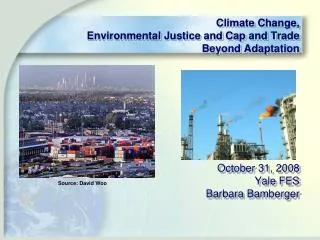
Source: David Woo Climate Change, Environmental Justice and Cap and TradeBeyond Adaptation October 31, 2008Yale FES Barbara Bamberger
Today’s Discussion • Environmental Justice (EJ) & Climate Change • Context of EJ and Global Warming Solutions Act (AB32) Legislation • Proposed Scoping Plan • Designing EJ into Cap and Trade
Environmental Justice and Climate Change • EJ Communities are effected: • Impacts to EJ communities as a result of climate change – Adaptation response • Impacts on EJ communities resulting from GHG reduction policies – Mitigation policies What are the implications to EJ communities from climate policy Who benefits? Who bears the cost?
Environmental Justice & Climate Change • Disproportionately impacted communities • Race, Ethnicity, low-income • Communities around Ports Sea level impacts, Rail yards, Shipyards, Goods Movement, Bulk Oil Unloading….Citing of Facilities • Urban – Power plants, refineries, shipyards, truck movement, rail yards • Rural – Agricultural bi-products, Biofuel plants • Access – health care and transit
EJ Definition • Federal: Exec Order 12898 (1994): • “the fair treatment of people of all races, income, and culture with respect to the development, implementation, and enforcement of environmental laws, regulations and policies.” • (EO12,898; Ca Government Code 65040.12 ( c ) and defined in statute by SB115, Chapter 690, Statutes 1999) ) • No person or group or people should shoulder a disproportionate share of the negative environmental impacts resulting from the execution of this country’s domestic and foreign policy programs.
The Making of AB32 • Global Warming Solutions Act (AB32) • Late 2005/2006 • Legislature – time to act • Governor – on board • Environmental NGOs – Co-sponsoring (NRDC, EDF) agnostic on C/T • EJ – concerns over C/T, holding support • Business – C/T
The Making of AB32 • AB32 “MUST” or “MAY” Include C/T • NGOs – held to ‘may’ due to EJ concerns • EJ – agreed to “May” with conditions, did not oppose bill, key language added to AB32 • Exec Order establishing “Market Advisory Committee” 2007 • February 2008 “EJ Declaration Against Cap/Trade”
AB32 EJ Language • NO Backsliding – existing emissions • NO Increases in co-pollutants locally • Ensure Co-Benefits (co-pollutants) to support public health and diversification of energy • Ensure NO Cumulative, Disparate Impacts (challenge for C/T analysis)
AB32 EJ Language • GHG regulation must: • NOT disproportionately impact low-income communities • Maximize additional environmental co-benefits and complement improvements in air quality • Complement efforts to achieve existing ambient air quality standards • Consider overall societal benefits including diversification of energy sources, economy, environment and public health
EJ Critique of Cap and Trade • Transformation to Low Carbon Economy • Too much risk to experiment, only 12 years to ‘get it right’ • Reductions first in EJ communities • Foregone benefits, Possible localized increases Offsets shift reductions elsewhere • Transparency in Trading • EIA, EIS, Community Right to Know, Participatory Justice • Existing Programs • Challenges to success: EU ETS, RECLAIM, RGGI
AB 32 Timeline 2007 2008 2009 2010 2011 2012 2020 Publish list of early actions Adopt Scoping Plan by 1/1/09 Adopt GHG reduction measures Reduce GHG emissions to 1990 levels Mandatory reporting & 1990 Baseline Launch Program
Scoping Plan • Reduce California’s GHG emissions to 1990 levels by 2020 • Protect and improve public health • Provide a model for regional, national and international programs • Grow the State’s economy and promote investment in green technology • Proposed Scoping Plan – October 2008 • Mix of strategies that combine market mechanisms, regulations, voluntary measures, and fees
Proposed Scoping Plan • Complementary measures • Direct Regulations: vehicle efficiency and low-carbon fuel standard, heavy-duty vehicle efficiency, high speed rail, refinery • CA Cap and Trade program linked to WCI • 33% renewable requirement on utilities • Sets a reduction goal for local governments • Fees: High GWP (refrigeration), public goods charge on water • Energy efficiency programs
California Cap-and-TradeReduction target 2020 Capped sector BAU: 512 MMTCO2E 1990: 365 MMTCO2E 147 MMTCO2E = Reduction target Direct measures: 112 MMTCO2E Cap-and-Trade: 35 MMTCO2E
Cap-and-Trade California cap-and-trade program caps emissions • industrial facilities (2012) • electricity (including imports) (2012) • commercial/residential fuel combustion (2015) • transportation fuels (2015) Begins in 2012 and declines over time to meet 2020 & 2050 targets Links to Western Climate Initiative to create regional market
Sector-Specific Measures CAPPED SECTORS • Transportation (Fuel Efficiency standard, LCFS, regional VMT targets) • Electricity (EEfficiency, 33% renewables, Solar Roofs and water heating) • Industry (Combustion sources, refineries, paper mills) UNCAPPED SECTORS • High Global Warming Potential Gases (New products and existing banks) • Forests (Preserve sequestration, biomass utilization) • Recycling & Waste (Landfill methane, high recycling/zero waste) • Agriculture (Methane capture at large dairies) • Industry (Fugitive emission sources)
Cap-and-Trade Definitions Cap: Total emissions for entire state or region Allowance: Permit to emit 1 ton CO2e per facility, based on total emissions, declines over time Compliance obligation: Requirement per facility based on total emissions (allowance + offset) Offset: A portion of total compliance obligation that can be reduced from non-capped sources. Western Climate: An alliance of 7 Western states and 4 Initiative Canadian provinces
Major Issues • Cap-and-Trade: Firm cap on 85 % of GHGs and cost-effective complementary measures. • Allocation: Will seek input from broad range of experts on how allowances should be distributed. Recommends: • Minimum of 10% auction in 2012 • Minimum of 25% auction in 2020 • 100% auction is a worthwhile goal • Offsets: At least half of the reductions must come from capped sources. All offsets must meet high quality standards. No geographic limits. • Use of Revenue: Many potential beneficial uses of revenue.
California Cap-and-TradeWhat is an Offset? • Quantification protocols would specify what reductions are real and additional for offsets to count • Examples: forests, manure management, waste management (landfill methane) • Safeguards to avoid regional and local health-based pollutants • Limited use per facility
Next steps: Retooling cap and trade design • Addressing EJ language in AB32 • Revenue stream generated by allowances • Co-pollutant and GHG Bifurcation (Stavins/Goulder) • Rethink cap and trade design itself and • Incorporate social elements into market mechanism • Design co-benefits into the architecture of cap and trade design • Provide economic incentives to reduce emissions in EJ communities into trading itself
Requires new thinking, new analysis of • cap and trade design measures: • Incorporates incentives for co-benefits utilizing economic tools • Create incentives for reductions in heavily-impacted communities • Addresses co-pollutant reductions, increases equity • Encourage reductions of GHG and associated health-based pollutants • Develop baseline data to track changes in cumulative emissions How to retool cap and trade design
Next steps: Retooling cap and trade design • Possible options: • Phase-in of trades amongst EJ communities • Discounting/price incentives for reductions in EJ communities • Limiting use of offsets in EJ communities • Restrict trading
Design Mechanisms for C/T • Next Steps: • Calling upon researchers to submit concepts on C/T Design, enforcement, transparency • Invitation will be released next week – submittals of abstracts due November 25th • Symposium in January/February 2009 • Cap and Trade Begins 2012