Understanding Energy: The Driving Force and Its Transformations
170 likes | 274 Vues
Energy is the capacity to perform work and cause change, measured in Joules. It exists in various forms: mechanical, electromagnetic, chemical, nuclear, and thermal. Energy can be categorized into potential and kinetic forms. Potential energy, such as gravitational and elastic energy, is stored by position or condition, while kinetic energy reflects energy in motion. The law of conservation of energy states that energy cannot be created or destroyed but can change forms. Einstein’s equation, E=mc², illustrates the relationship between mass and energy, emphasizing their interconvertibility.


Understanding Energy: The Driving Force and Its Transformations
E N D
Presentation Transcript
ENERGY THE DRIVING FORCE
What is Energy? • The ability to do work • The ability to cause change • Measured in Joules, just like work • Formula Symbol: E • as in E = mc2
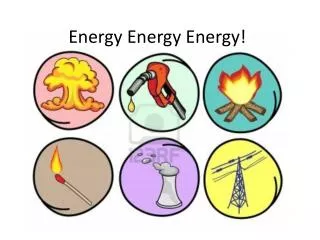
Forms of Energy • Mechanical Energy • Describes energy stored and released according to function or force
Forms of Energy • Electromagnetic Energy • Waves of mostly invisible energy • Includes light, radio waves, X-rays
Forms of Energy • Chemical Energy • Stored and released in the bonds between atoms
Forms of Energy • Nuclear Energy • Stored and released from the nucleus of an atom
Forms of Energy • Thermal Energy • Heat in all its forms and flows
Two descriptions of Energy • Potential Energy • Energy stored by position or condition • Kinetic Energy • Released energy or energy of motion
Potential Energy • The easiest quantified PE is Gravitational PE • This is the PE stored in an object by its height above another reference point • PEGravitational = m g h Joules = kg●(m/s2) ●m Remember, g = 9.8 m/s2
Potential Energy, revisited… • Another form is Elastic PE • This is the PE stored in an object by its being disturbed from its natural state, • and how much it wants to return to that natural state • Good examples: • Springs, swings, pendulums, rubber bands
Kinetic Energy • This is the KE released by an object by its motion • KE = ½ m v2 • Joules = kg●(m/s)2
Problems • A 3.0-kilogram toy dump truck moving with a speed of 2.0 m/s starts up a ramp. How high does the truck roll before it stops? • A 2.0-kilogram ball rolling along a flat surface starts up a hill. If the ball reaches a height of 0.63 meters, what was its initial speed?
Problems • Find the potential energy of this roller coaster when it is halfway down the hill. • A 2.0-kilogram ball is tossed straight up with a kinetic energy of 196 joules. How high does it go?
Law of Conservation of Energy • Energy can not be created or destroyed in normal reactions • Energy can be changed from one form to another • The total amount of energy must be the same before and after a change in energy
Most common energy conversion is from potential to kinetic energy • Gravitational potential energy of an object is converted to kinetic energy as the object falls. • Potential energy can become kinetic and vice versa. • Example: Pendulums
Energy and Mass • Einstein’s famous equation • E = mc2 • m = mass • c = speed of light (3 x 10⁸ m/s) • Shows that matter can be converted into energy and energy can be converted into mass.