
SlideServe
Menu
Préférences
© SlideServe · v2026

The Role of Law in Directing Human Action: Insights from Hobbes

zada avatar
1 diapositives · 209 Views · Sep 06, 2014

Thomas Hobbes emphasizes that the purpose of law is not to restrict voluntary actions but to guide individuals in a way that protects them from their own impulsive desires and indiscretions. According to Hobbes, the existence of laws should ultimately facilitate peace and stability in society. He argues that unnecessary laws are not beneficial and that the ruler's power relies on the well-being of subjects. Through Hobbes's perspective, we learn that governance should balance authority with the freedom of the people for a harmonious society.
The Role of Law in Directing Human Action: Insights from Hobbes - slide 1
01 / 1The Role of Law in Directing Human Action: Insights from Hobbes
1 / 17

Télécharger la présentation

The Role of Law in Directing Human Action: Insights from Hobbes
Une image / un lien ci-dessous est fourni (tel quel) pour télécharger la présentation

Politique de téléchargement : le contenu du site vous est fourni TEL QUEL pour votre information et votre usage personnel ; il ne peut être vendu, concédé sous licence ni partagé sur d’autres sites sans l’accord de son auteur.Le contenu vous est fourni TEL QUEL, pour votre information et votre usage personnel uniquement. Téléchargez la présentation en cliquant sur ce lien. Lors du téléchargement, si vous ne parvenez pas à télécharger une présentation, l’éditeur a peut-être supprimé le fichier de son serveur.Pendant le téléchargement, si vous ne parvenez pas à obtenir une présentation, le fichier a peut-être été supprimé par l’éditeur.

F I N

Plus de contenu associé

Transcription de la présentation
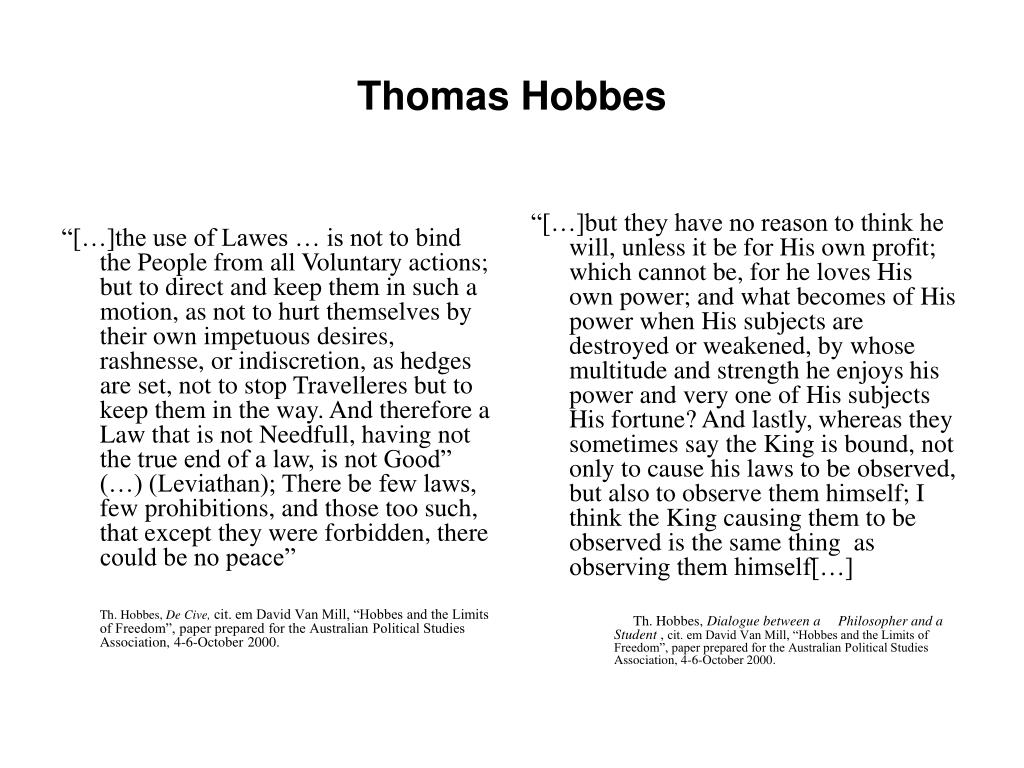
  1. “[…]the use of Lawes … is not to bind the People from all Voluntary actions; but to direct and keep them in such a motion, as not to hurt themselves by their own impetuous desires, rashnesse, or indiscretion, as hedges are set, not to stop Travelleres but to keep them in the way. And therefore a Law that is not Needfull, having not the true end of a law, is not Good” (…) (Leviathan); There be few laws, few prohibitions, and those too such, that except they were forbidden, there could be no peace” Th. Hobbes, De Cive, cit. em David Van Mill, “Hobbes and the Limits of Freedom”, paper prepared for the Australian Political Studies Association, 4-6-October 2000. “[…]but they have no reason to think he will, unless it be for His own profit; which cannot be, for he loves His own power; and what becomes of His power when His subjects are destroyed or weakened, by whose multitude and strength he enjoys his power and very one of His subjects His fortune? And lastly, whereas they sometimes say the King is bound, not only to cause his laws to be observed, but also to observe them himself; I think the King causing them to be observed is the same thing as observing them himself[…] Th. Hobbes, Dialogue between a Philosopher and a Student , cit. em David Van Mill, “Hobbes and the Limits of Freedom”, paper prepared for the Australian Political Studies Association, 4-6-October 2000. Thomas Hobbes