Key terms
70 likes | 179 Vues
Explore the revolutionary art of Caravaggio, an Italian Baroque master known for his dramatic use of light and shadow—Tenebroso. His works, such as "The Calling of St. Matthew" and "The Conversion of St. Paul," transform genre scenes into compelling narratives, utilizing elements like diagonal composition and chiaroscuro. Caravaggio's unique approach to realism challenges the ideals of his time, emphasizing emotional intensity and spiritual depth. Delve into his iconic paintings that blend still life with themes of sacrifice, embodying the complexity of human experience.


Key terms
E N D
Presentation Transcript
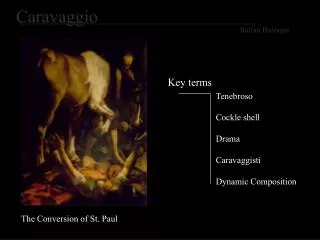
Caravaggio Italian Baroque Key terms Tenebroso Cockle shell Drama Caravaggisti Dynamic Composition The Conversion of St. Paul
Caravaggio Italian Baroque Appropriation from Michelangelo Use of Tenebroso Genre scene turned into Drama Light creates a spiritual element Stage is set though the use of Light The Calling of St. Matthew, 1600
Caravaggio Italian Baroque cockle shell = pilgrim shadow = halo & macabre uses peasants foreshortening table set for the viewer Baroque still life elements Use of Red = sacrifice Supper at Emmaus, 1600
Caravaggio dramatic lighting “rule of thirds” grotesque realism peasants as models Christ is highlighted diagonal composition The Incredulity of St. Thomas, 1602
Caravaggio Realism not Idealism Strong Diagonal Tension Dramatic scene Use of Red represents blood Tenebroso Crucifixion of St. Peter, 1600
Caravaggio Drama! Divine intervention Lamb represents sacrifice Strong diagonal Uses Red to represent blood and sacrifice Sacrifice of Isaac, 1603
Caravaggio Baroque still life painter Uses chiaroscuro Bacchus as a dramatic subject Mellow portrayal of Bacchus Shows fruit with reference to sin Bacchus, 1597