Understanding Equilibrium Constants (Kc) in Chemical Reactions
This guide explores the evaluation of equilibrium constants (Kc) for chemical reactions. It explains how to derive Kc expressions, calculate equilibrium concentrations, and analyze how Kc varies with temperature, but remains unaffected by changes in concentration or pressure. Examples include the synthesis of ammonia and the esterification reaction, detailing the steps to construct balanced equations, determine moles at equilibrium, and compute Kc values with appropriate units. This resource is essential for students and professionals interested in chemical equilibrium.

Understanding Equilibrium Constants (Kc) in Chemical Reactions
E N D
Presentation Transcript
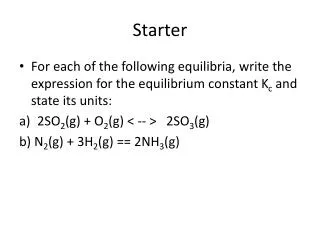
Starter • For each of the following equilibria, write the expression for the equilibrium constant Kc and state its units: • 2SO2(g) + O2(g) < -- > 2SO3(g) b) N2(g) + 3H2(g) == 2NH3(g)
Calculations using Kc L.O.: Calculate the concentrations or quantities of substances present at equilibrium Calculate the value of Kc, including its units
THE EQUILIBRIUM CONSTANT Kc for an equilibrium reaction of the form... aA + bB cC + dD then (at constant temperature)[C]c . [D]d= a constant,(Kc) [A]a . [B]b where[ ]denotes the equilibrium concentration in mol dm-3 Kcis known as the Equilibrium Constant
THE EQUILIBRIUM CONSTANT Kc for an equilibrium reaction of the form... aA + bB cC + dD then (at constant temperature)[C]c . [D]d= a constant,(Kc) [A]a . [B]b where[ ]denotes the equilibrium concentration in mol dm-3 Kcis known as the Equilibrium Constant VALUE OF Kc AFFECTEDby a change of temperature NOTAFFECTEDby a change in concentration of reactants or products a change of pressure adding a catalyst
A(g) + B(g) C(g) 0.50 mol of A and 0.40 mol of B were mixed in a 10 dm3 container. At equilibrium there were 0.2 mol of A. What is the value of Kc?
CALCULATIONS INVOLVING Kc • construct the balanced equation, including state symbols (aq), (g) etc. • determine the number of moles of each species at equilibrium • divide moles by volume (in dm3) to get the equilibrium concentrations in mol dm-3 • (If no volume is quoted, use a V; it will probably cancel out) • from the equation constructed in the first step, write out an expression for Kc. • substitute values from third step and calculate the value of Kc with any units • Example 1 • One mole of ethanoic acid reacts with one mole of ethanol at 298K. When equilibrium is reached it is found that two thirds of the acid has reacted. Calculate the value of Kc.
CALCULATIONS INVOLVING Kc • construct the balanced equation, including state symbols (aq), (g) etc. • determine the number of moles of each species at equilibrium • divide moles by volume (in dm3) to get the equilibrium concentrations in mol dm-3 • (If no volume is quoted, use a V; it will probably cancel out) • from the equation constructed in the first step, write out an expression for Kc. • substitute values from third step and calculate the value of Kc with any units • Example 1 • One mole of ethanoic acid reacts with one mole of ethanol at 298K. When equilibrium is reached it is found that two thirds of the acid has reacted. Calculate the value of Kc. • CH3COOH(l) + C2H5OH(l) CH3COOC2H5(l) + H2O(l)
CALCULATIONS INVOLVING Kc • construct the balanced equation, including state symbols (aq), (g) etc. • determine the number of moles of each species at equilibrium • divide moles by volume (in dm3) to get the equilibrium concentrations in mol dm-3 • (If no volume is quoted, use a V; it will probably cancel out) • from the equation constructed in the first step, write out an expression for Kc. • substitute values from third step and calculate the value of Kc with any units • Example 1 • One mole of ethanoic acid reacts with one mole of ethanol at 298K. When equilibrium is reached it is found that two thirds of the acid has reacted. Calculate the value of Kc. • CH3COOH(l) + C2H5OH(l) CH3COOC2H5(l) + H2O(l) • moles (initially) 1 1 0 0 • moles (at equilibrium) 1 - 2/3 1 - 2/32/32/3 Initial moles of CH3COOH = 1 moles reacted = 2/3 equilibrium moles of CH3COOH = 1/3 For every CH3COOH that reacts; a similar number of C2H5OH’s react (equil moles = 1 - 2/3) a similar number of CH3COOC2H5’s are produced a similar number of H2O’s are produced
CALCULATIONS INVOLVING Kc • construct the balanced equation, including state symbols (aq), (g) etc. • determine the number of moles of each species at equilibrium • divide moles by volume (in dm3) to get the equilibrium concentrations in mol dm-3 • (If no volume is quoted, use a V; it will probably cancel out) • from the equation constructed in the first step, write out an expression for Kc. • substitute values from third step and calculate the value of Kc with any units • Example 1 • One mole of ethanoic acid reacts with one mole of ethanol at 298K. When equilibrium is reached it is found that two thirds of the acid has reacted. Calculate the value of Kc. • CH3COOH(l) + C2H5OH(l) CH3COOC2H5(l) + H2O(l) • moles (initially) 1 1 0 0 • moles (at equilibrium) 1 - 2/3 1 - 2/3 2/3 2/3 • equilibrium concs. 1/3 / V 1/3 / V 2/3 / V 2/3 / V • V = volume (dm3) of the equilibrium mixture
CALCULATIONS INVOLVING Kc • construct the balanced equation, including state symbols (aq), (g) etc. • determine the number of moles of each species at equilibrium • divide moles by volume (in dm3) to get the equilibrium concentrations in mol dm-3 • (If no volume is quoted, use a V; it will probably cancel out) • from the equation constructed in the first step, write out an expression for Kc. • substitute values from third step and calculate the value of Kc with any units • Example 1 • One mole of ethanoic acid reacts with one mole of ethanol at 298K. When equilibrium is reached it is found that two thirds of the acid has reacted. Calculate the value of Kc. • CH3COOH(l) + C2H5OH(l) CH3COOC2H5(l) + H2O(l) • moles (initially) 1 1 0 0 • moles (at equilibrium) 1 - 2/3 1 - 2/3 2/3 2/3 • equilibrium concs. 1/3 / V 1/3 / V 2/3 / V 2/3 / V • V = volume (dm3) of the equilibrium mixture • Kc = [CH3COOC2H5] [H2O] • [CH3COOH] [C2H5OH]
CALCULATIONS INVOLVING Kc • construct the balanced equation, including state symbols (aq), (g) etc. • determine the number of moles of each species at equilibrium • divide moles by volume (in dm3) to get the equilibrium concentrations in mol dm-3 • (If no volume is quoted, use a V; it will probably cancel out) • from the equation constructed in the first step, write out an expression for Kc. • substitute values from third step and calculate the value of Kc with any units • Example 1 • One mole of ethanoic acid reacts with one mole of ethanol at 298K. When equilibrium is reached it is found that two thirds of the acid has reacted. Calculate the value of Kc. • CH3COOH(l) + C2H5OH(l) CH3COOC2H5(l) + H2O(l) • moles (initially) 1 1 0 0 • moles (at equilibrium) 1 - 2/3 1 - 2/3 2/32/3 • equilibrium concs. 1/3 / V 1/3 / V 2/3 / V 2/3 / V • V = volume (dm3) of the equilibrium mixture • Kc = [CH3COOC2H5] [H2O] = 2/3 / V . 2/3 / V = 4 • [CH3COOH] [C2H5OH] 1/3 / V . 1/3 / V
Finding equilibrium concentrations from Kc values For the following equilibrium system, Kc = 0.1 X(g) Y(g) If 10 moles of X were allowed to reach equilibrium, how many moles of Y would there be in the equilibrium mixture?
4.2 Exercise 1 - Kc Q 4-11 Note: you can find similar examples in Q4 of chem factsheet no 21