SlideServe
Menu
Préférences
© SlideServe · v2026

Qualitative Case Study: Definitions

zamir avatar
8 diapositives · 1.8K Views · Oct 18, 2012

Qualitative Case Study: Definitions. Case study is “the study of the particularity and complexity of a single case, coming to understand its activity within important circumstances” (Stake, 1995, p. xi).
Qualitative Case Study: Definitions - slide 1
01 / 8Qualitative Case Study: Definitions
1 / 17

Télécharger la présentation

Qualitative Case Study: Definitions
Une image / un lien ci-dessous est fourni (tel quel) pour télécharger la présentation

Politique de téléchargement : le contenu du site vous est fourni TEL QUEL pour votre information et votre usage personnel ; il ne peut être vendu, concédé sous licence ni partagé sur d’autres sites sans l’accord de son auteur.Le contenu vous est fourni TEL QUEL, pour votre information et votre usage personnel uniquement. Téléchargez la présentation en cliquant sur ce lien. Lors du téléchargement, si vous ne parvenez pas à télécharger une présentation, l’éditeur a peut-être supprimé le fichier de son serveur.Pendant le téléchargement, si vous ne parvenez pas à obtenir une présentation, le fichier a peut-être été supprimé par l’éditeur.

F I N

Plus de contenu associé

Transcription de la présentation
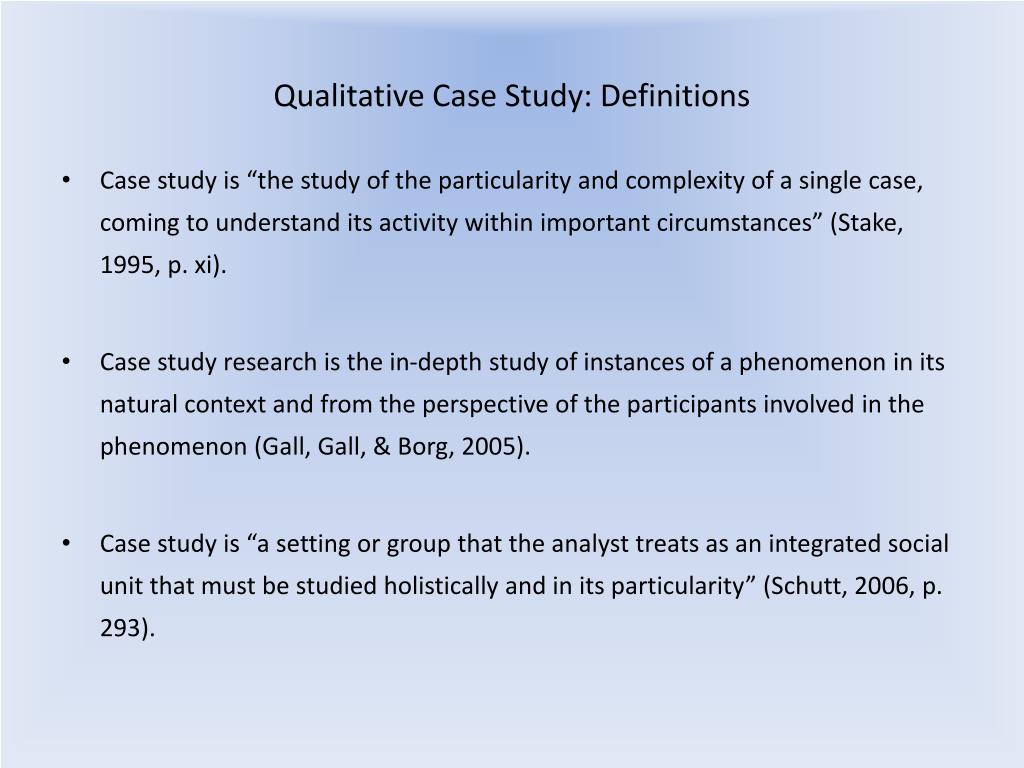
  1. Qualitative Case Study: Definitions • Case study is “the study of the particularity and complexity of a single case, coming to understand its activity within important circumstances” (Stake, 1995, p. xi). • Case study research is the in-depth study of instances of a phenomenon in its natural context and from the perspective of the participants involved in the phenomenon (Gall, Gall, & Borg, 2005). • Case study is “a setting or group that the analyst treats as an integrated social unit that must be studied holistically and in its particularity” (Schutt, 2006, p. 293).

  2. Case Study vs. Ethnography • Similarity: focus on a case or cases; in-depth study; natural context; emic and etic perspectives • Differences (Gall et al., 2005):

  3. Case Study: Advantages • Gain a holistic understanding of real-life events • Seek ‘uniqueness’ and ‘commonality’ • Refine and develop theories • Generate new insights • Allow for readers’ decision-making • Reflect on human experience • Suggest a step to action

  4. Case Study: Limitations • Concerns about generalizability • Use of "abnormal" cases • Issues connected with thick description and triangulation • Objectivity versus subjectivity • The data-driven rather than theory-driven approach • Attrition • Constraints on quantitative analysis of small-sample data, • Ethics in protecting the privacy of participants (Duff, 2008)

  5. Qualitative Case Study: Data analysis • Interpretational analysis involves a systematic set of procedures to code and classify qualitative data to ensure that the important constructs, themes, and patterns emerge. • Structural analysis Structural analysis involves a precise set of procedures for analyzing qualitative data that do not need to be inferred from the data but are inherent features of the discourse, text, or events that the researchers are studying. • Reflective analysis Reflective analysis refers to a process in which qualitative researchers rely mainly on their own intuition and personal judgment to analyze the data that have been collected; it can also involve critical appreciation. (Gall et al., 2005)

  6. How does case study inform my research? Case study informs my research in terms of • Nature of my study: real-life context; exploratory and descriptive • Research methods: interview and observation • Sampling strategy: convenience sampling • Data analysis: interpretational and reflective • Report of findings: emic and etic perspetives • Expected outcomes: extract ‘commonality’ and ‘uniqueness’, transferability to some extent

  7. My Current Questions Regarding the Methodology • Should I study my participants as a single case or multiple cases? That is to say, should the unit of analysis be the group of immigrant Chinese teachers or individual teachers in my research? • Do I need to conduct a cross-case analysis?

  8. References • Cohen, L., & Manion, L. (1994). Research methods in education. USA: Routledge. • Duff, P. (2008). Case study research in applied linguistics. Lawrence Erlbaum Associates. • Gall, J. P., Gall, M. D., & Borg, W. R. (Eds.). (2005). Applying educational research: A practical guide. USA: Pearson Education, Inc. • McMillan, J. H., & Schumacher, S. (2006). Research in education: Evidence-based inquiry. USA: Pearson Education, Inc. • Schutt, R. K. (2006). Investigating the social world: The process and practice of research. London: Sage Publications. • Stake, R. E. (1995). The art of case study research. Thousand Oaks, CA: Sage Publications. • Stake, R. E. (2000). Case studies. In N. K. Denzin & Y. S. Lincoln (Eds.), The handbook of qualitative research (pp. 435-452). London: Sage Publications. • Yin, P. K. (2003). Case study research (3rd ed.). Thousand Oaks, CA: Sage Publications.