Aurora Sound Waves: Unraveling the Mystery in the Northern Lights
360 likes | 466 Vues
Explore the intriguing question of whether magnetic waves in the aurorae can be transformed into sound waves. Discover the chain of events from solar energy to the creation of the aurora, including the role of magnetic reconnection. Delve into the psychological and physical explanations for possible audible sounds from aurorae. Learn about the transmission of sun-generated sound waves into magnetic waves and the potential resonance in the aurora. Investigate the concept of β as a factor in transforming magnetic waves into sound waves in Earth's atmosphere. Join the exploration with insights from experts and sources such as NOAA, NASA, and more.


Aurora Sound Waves: Unraveling the Mystery in the Northern Lights
E N D
Presentation Transcript
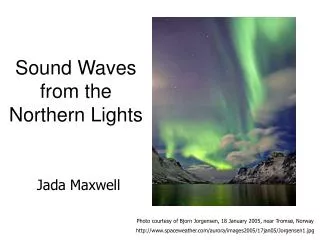
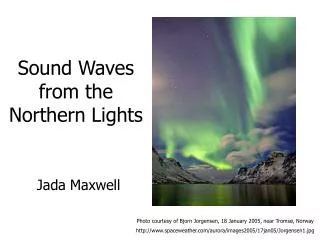
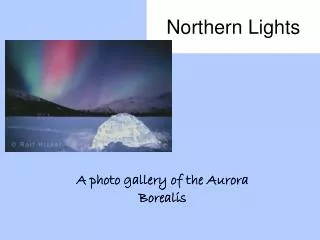
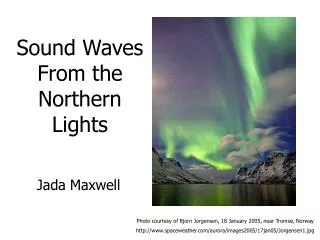
Sound Waves From the Northern Lights Jada Maxwell Photo courtesy of Bjorn Jorgensen, 18 January 2005, near Tromsø, Norway http://www.spaceweather.com/aurora/images2005/17jan05/Jorgensen1.jpg
“Synergy means behavior of whole systems unpredicted by the behavior of their parts taken separately.”- Buckminster Fuller
Can magnetic waves in the aurorae transform into sound waves? • What creates the aurora? • Sound waves from the aurora • Wave transformation on the Sun • Beginning to answer my question
The aurora is created by a chain of events, beginning with energy from the sun. Chain of Events Image courtesy of Tom Michalikhttp://faculty.rmwc.edu/tmichalik/solarwind.htm
The Magnetosphere Image courtesy of Minnesota Technologhttp://technolog.it.umn.edu/technolog/novdec97/cover.htm
Coronal Mass Ejection (CME) Illustration by Steele Hill, courtesy of NASAhttp://sohowww.nascom.nasa.gov/localinfo/steele.html
Particles Spiral Down Field Lines Image: Fundamentals of Physics, 2005
Particles 2 Particles Spiral Down Field Lines • Collide with atomic and molecular oxygen and nitrogen • Emit energy as light
This Creates the Aurorae • Northern Lights = Aurora Borealis • Southern Lights = Aurora Australis Image courtesy of Shawn Malonehttp://www.lakesuperiorphoto.com
Nearly Mirror Images Aurora Borealis Aurora Australis Images courtesy of NOAAhttp://sec.noaa.gov/pmap/
Can we hear the aurorae? • Anecdotal evidence of auroral sounds • hissing, popping, crackling, swooshing • corresponds with motions of light
6 minutes • Sound would take at least 6 minutes to travel from the aurora to the ground • No recordings of audible aurorae
Explanations of Audible Sounds • Psychological • Freezing Breath • “Brush discharge”
Evidence of Infrasoundfrom Aurorae • Humans can hear between 20 and 20,000 Hertz (Hz) • Infrasound is below 20 Hz • Currently being investigated • Gas expansion
Energy of Sound Waves is Transformed into Magnetic Waves Sun
Types of Magnetic Waves • Alfvén waves (s-mode) • Magnetosonic waves (p-mode) Images courtesy of Georgia State Universityhttp://hyperphysics.phy-astr.gsu.edu/hbase/sound/tralon.html BBC animations
My Question Can magnetic waves in the aurorae transform into sound waves?
Magnetic Waves Earth
Finding Beta Gas (atmospheric) Pressure Beta = β = Magnetic Field Pressure β = 1 ?
Resonance • All material has a frequency that it vibrates at • Matching the frequency allows the material to absorb energy • Singing wine glass
Resonance in the Aurora When β = 1, • Energy from magnetic waves can be transferred to the atmosphere • Found the right frequency
When Beta = 1 β= 1 ? • At 120 km • Near bottom of aurorae
More Questions to Investigate • How does β vary? • Compare gas expansion theory to wave transformation • How much might Alfvén and magnetosonic waves each contribute to this effect? • Which is more likely to transform?
Thanks to: • Dr. E.J. Zita for her guidance and helpful discussions • Beth Stinson for instruction in PowerPoint
Image Sources: • NOAA (National Oceanic & Atmospheric Administration)http://sec.noaa.gov/pmap/ • NASAhttp://sohowww.nascom.nasa.gov/localinfo/steele.html • SpaceWeather.com http://www.spaceweather.com/aurora/images2005.htm • Shawn Malonehttp://www.lakesuperiorphoto.com • Tom Michalikhttp://faculty.rmwc.edu/tmichalik/solarwind.htm • Minnesota Technologhttp://technolog.it.umn.edu/technolog/novdec97/cover.htm • Fundamentals of Physics, Halliday/Resnick/Walker, John Wiley & Sons, 2005, p 746