Download
1 / 19
190 likes | 311 Vues
This overview explores the unique governance model of Iran, characterized by its theocratic republic framework that merges Islamic principles with elements of democracy. The roles of key institutions, including the Supreme Leader, Guardian Council, Assembly of Religious Experts, and Expediency Council, are detailed. The dual executive system featuring both the Supreme Leader and the President, alongside the highly centralized unitary state structure, shapes policymaking and governance in Iran. The influence of the clerical establishment and the mechanisms of election and legislation are also highlighted.

E N D
IRAN Part 2: Governance & Policymaking
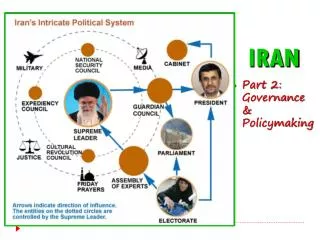
The Basics • Theocratic Republic • Theocracy with democratic elements • Theocratic Institutions: • Supreme Leader • Guardian Council • Assembly of Religious Experts • Expediency Council • Highly Centralized Unitary State • But is divided administratively into provinces, districts, sub-districts, and local areas • Dual Executive (HOS, Supreme Leader; HOG, President) • Unicameral Legislature • Judiciary not independent; Based on Sharia Law
The Supreme Leader (Head of State) • Currently: Ayatollah Ali Khamenei • Most powerful political figure (1989 change from qualification to be supreme leader of being highest-ranking Shi’ite cleric to whoever was an established member of the clergy) • Chosen by the clerics who make up the Assembly of Experts • Appointed for Life • Expected to act as a trustee of community by supervising politics and ensuring laws conform to Islam • Faqih– leading Islamic jurist to interpret the meaning of religious documents/sharia law
The Supreme Leader • Powers: • Authority to overrule/dismiss president • Command of armed forces • Declaration of war and peace • Issue decrees for national referenda • Appoint head of judiciary • Appoint half of the members of the Guardian Council • Appoint Friday prayer leaders and the head of radio and TV
The Guardian Council • 12 member council, serve 6 year terms • 6 clerical members appointed by supreme leader • 6 lay members (lawyers) recommended by head of judiciary, subject to approval of parliament (vote mainly on question of constitutionality of legislation) • Council has power to veto any legislation passed by parliament that is at odds with basic tenants of Islam • Vetting Power • Has right to determine who can run in local, presidential, parliamentary, and Assembly of Religious Experts elections
The Assembly of Religious Experts • 86 members (no females) • Directly elected by people for 8 year terms • Government screened; candidates must pass a religious examination • Meets for at least two days twice a year • Elects Supreme Leader & has right to dismiss him • Candidates are subject to approval by Guardian Council
The Expediency Council • 32 members appointed by Supreme Leader • Includes President, chief judge, speaker of the Majles, jurists from Guardian Council (collectively most powerful men in Iran) • Serve 5 year terms • Designed to settle disputes between Majles and Guardian Council • May originate its own legislation
The President • Head of Government • Currently: Hassan Rouhani • 4 year term • 8-year consecutive term limit • Directly elected by the people • Universal suffrage (18 or older) • Absolute majority of votes • Top two run a week later • Candidates approved by Guardian Council • 2005 Election disqualified 1,000 candidates (left only 7 to run) • 2009 Election – Accusations/Protests about voter fraud • John Green’s thoughts
The President • Qualifications: • Between ages of 25 and 75 • “Well-known personality clause” in constitution allows Guardian Council to bar women • “Shi’ite sect” qualification bars Sunni Muslims, Christians, Jews, Zoroastrians and other religious minorities • Historically a cleric, but not Ahmadinejad • Powers: • Selects vice presidents (currently 10) & cabinet members • Devises budget & presents legislation to parliament • Signs treaties, laws & agreements • Chairs National Security Council • Appoints provincial governors, town mayors & ambassadors
The Bureaucracy • Headed by President • Grown since the revolution • Dominated by clergy • Most important ministries: • Culture and Islamic Guidance (controls media and enforces “proper conduct” in public life) • Intelligence (replaced shah’s SAVAK) • Heavy Industries (manages nationalized factories) • Reconstruction (expands social services and takes “true Islam” to countryside)
The Legislature/Majles • 290 deputies, 4 year terms • Five guaranteed seats for recognized religious minorities: Christians, Jews, and Zoroastrians • Non-recognized religious minorities (e.g., Baha’is) cannot run • Direct Elections • Elections held on a nonpartisan basis (ballots do not have party identification or philosophy) • 28 multimember districts (based on population size) • Campaign period only one week long • Campaign literature 4 by 6 inches maximum • 37% drop in clerics elected to Majles between 1980 and 2000 • Two round voting: • Candidate must receive at least 25% on first ballot • If more candidates clear this threshold to fill a district’s seats: second round held several months later for top two candidates with the most support
The Legislature/Majles • Qualifications • Candidates submit their names to subcommittee of Guardian Council, which determines who can run • Age 30-75 • Those running for first time must have equivalent of university degree • Must have a “belief in and commitment in practice to Islam and the sacred system of the Islamic Republic of Iran” • In 1992 and 1996, kept 1/3 off ballot • In 2000, kept only 11% off the ballot • In 2004, almost 3,000 kept off ballot
The Legislature/Majles • Not rubber-stamp institution • Powers • Enact/Change laws (with approval of Guardian Council) • Appoint 6 of 12 members of Guardian Council, chosen from a list drawn up by chief judge • Investigate cabinet ministers and public complaints against executive and judiciary • Remove cabinet members (not president) • Approve budget, cabinet appointments, treaties & loans
The Judiciary • Based on Sharia Law • Not independent • Supreme leader appoints head of judiciary who appoints senior judges • Penal Code (Retribution Law)—very strict/harsh • Stoning, death penalty for many “crimes” (adultery, homosexuality, habitual drinking) • Evidence of one male Muslim = evidence of two female Muslims • Modernized penalties, but high rate of executions
The Military • Regular army of 370,000 • Revolutionary Guards (est after 1979) • 125,000 active troops, commanders appointed by Supreme Leader • Has its own ground forces, navy and air force, and oversees Iran's strategic weapons. • Controls the volunteer paramilitary Basij Resistance Force • Controls powerful bonyads (charitable foundations), which run a considerable part of the Iranian economy. • Control around a third of Iran's economy through a series of subsidiaries and trusts
Bonyads • After the Revolution, they were nationalized • Supposed to redistribute income to poor and families of martyrs (i.e. those killed in the service of the country) • Over 100 • Tax-exempt, government subsidized, consortiums, receiving religious donations and answerable directly (and only) to Supreme Leader • Monopolize many sectors of the economy (e.g., cement, sugar)) • Patronage-oriented holding companies that ensure the channeling of revenues to groups supporting the regime
The Military • According to Constitution, regular army defends the borders, while the Revolutionary Guards protect the republic
Review • Discussion Question: What elements of Iran’s political system make it theocratic? Which elements make it democratic? Theocratic Democratic