Ching-Yen Beh Software Implementation PCB layout Robert Stookey Hardware Implementation
This project presents a handheld I2C protocol analyzer designed to facilitate debugging and testing of I2C communications. It utilizes a master/slave architecture with bi-directional serial bus lines, achieving data rates of up to 400 Kbps. The device features an LCD for displaying decoded bus data and supports storage of 128 bytes of sniffed data. Key considerations include manufacturability, low power consumption (4-hour operation on 2 AA batteries), and user-friendly interface modifications. The project is a collaborative effort led by Ching-Yen Beh under the guidance of Dr. J. W. Bruce.
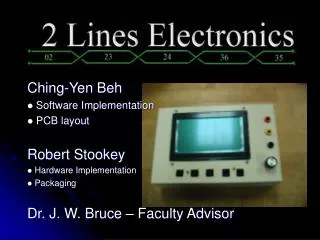

Ching-Yen Beh Software Implementation PCB layout Robert Stookey Hardware Implementation
E N D
Presentation Transcript
Ching-Yen Beh Software Implementation PCB layout Robert Stookey Hardware Implementation Packaging Dr. J. W. Bruce – Faculty Advisor
Overview • I2C background • Design Project • Design Specification • Demo Project • Device Testing • Completed Tasks • Final Thanks
I2C Slave I2C Slave I2C Master Data byte Data byte Data byte Encode/ Decode Encode/ Decode SDA Encode /Decode Encode/ Decode SCL Data byte I2C Slave I2C? • Digital Peripheral Communications • 2 bi-directional serial bus lines • Involves Master and Slave devices
Data byte (F1) Problem • Debug complexity and high cost test equipment Figure represents I2C data SDA SCL Start Stop Signal Signal
Project • I2C Analyzer • Display decoded bus data on LCD screen • Hand-held device for portability • Used as a design tool for the I2C protocol
Push Button 1 Ubicom SX52 Push Button 2 LCD Module Push Button 3 Push Button 4 Push Button 5 12 Rotary Encoder 2 SDA SCL GND Hardware Block Diagram
Background Foreground Detect Data Read Data from memory Store Data Analyze Data Push Button Display Waveform Rotary Encode Software Implementation
Design Specification • Performances • I2C Mode Support • 100K bps in Standard Mode • 400K bps in Fast Mode • Show data in waveform • Store 128 bytes of sniffed data for best case • Physical appearance • Handheld Device (approx. 6” x 6” x 2” ). • Not more than 2.5 lbs. • Powerconsumption • 4 Hour Operation
Design Consideration • Manufacturability • Our device can be easily mass produced for a cheap cost. • Simple circuit requires less machining time. • Small parts require SMT technology
Device Testing • Microprocessors II class project • Multiple I2C devices • All different data lengths • Data Bus Speeds • 100 and 400 kbits/second • Power Consumption • Battery life
Further Implementation • Device powered by 2 AA batteries. • Support the I2C high speed mode. • More user friendly interface. • User able to control the contrast of the LCD. • Add fuse to the External Ground Lead.
Problem Discovered • Two MCU and programmer burned with unknown reason.
Problem discovered • Display turn off or system hang after few seconds.
Problems Discovered • Give wrong output while pushing the Read/Write button for long time. • Unable to support 400K bps I2C data.
Timeline • Project completed on time
References • www.semiconductors.philips.com • I2C Specification • www.ubicom.com • Controller and software information • www.allelectronics.com • LCD manual and specification • www.maxim-ic.com • DC/DC Converter design specification
Special Thanks to… • Faculty advisor – Dr. J.W.Bruce • Aimee Imparato from Project Futility, and Rick King from Team Oppenheimer Technologies • Walter Steverson, and Kenneth Fazel from Team IRS