Understanding Stakeholder Involvement: Analysis for Successful Business Strategies
Stakeholders are defined as individuals or groups with a vested interest in an organization's performance, including employees, managers, shareholders, suppliers, customers, and the community. Stakeholder analysis is a crucial tool for assessing how these expectations influence organizational goals. By utilizing a Power/Interest matrix, businesses can categorize stakeholders based on their influence and interest levels. This analysis helps identify key blockers and facilitators during strategy formulation, allowing managers to reconcile conflicting stakeholder expectations and align them with business objectives for successful strategy implementation.

Understanding Stakeholder Involvement: Analysis for Successful Business Strategies
E N D
Presentation Transcript
Stakeholder Involvement By Suhel Khan
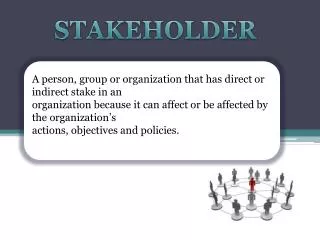
Stakeholders • Stakeholders can be defined as “those groups or individuals who have a stake in, or expectation of, the organisation’s performance and include employees, managers, shareholders, suppliers, customers and the community at large” (Johnson and Scholes, 1993).
Stakeholder Analysis • This is a tool that can be useful in understanding how expectations of groups and individuals influence the purposes of an organisation. In other words, a stakeholder analysis is a technique that one can use to identify and assess the importance of key people, groups of people, or institutions that may significantly influence the success of a business activity. In graphical terms stakeholder analysis can be illustrated with the use of the following Power/Interest (Stake) matrix:
Low Stake High Stake Low Power High Power
The above matrix clearly classifies stakeholders in relation to the power they hold and the extent to which they are likely to show interest in the organisation’s strategies. The matrix also establishes the type of relationship which the organisation will need to establish with each stakeholder group. The above analysis can help to identify which group of stakeholders are likely to be the key blockers and facilitators of change are in relation to new business strategy formulation. This is important as managers need to identify conflicting expectations of stakeholder groups and need to construct strategies to suit their business goals and objectives and at the same time manage stakeholder expectations to ensure acceptance of the strategies which are formulated