Download
1 / 13
160 likes | 296 Vues
Photosynthesis is a crucial process for life on Earth, occurring in chloroplasts where light-dependent and light-independent reactions take place. In light-dependent reactions, sunlight energizes chlorophyll, splitting water into oxygen and generating energy-rich molecules like NADPH and ATP. These molecules drive the light-independent reactions, also known as the Calvin Cycle, in the stroma, where CO2 is transformed into glucose. This intricate cycle involves the conversion of carbon chains, showcasing the remarkable efficiency of plants in harnessing solar energy to produce organic compounds necessary for growth.

E N D
PhotosyntheticReactions • Light dependent reactions • Light independent reactions (Calvin Cycle)
Light Reactions Light dependent reactions take place in the thylakoid membrane, with the pigment chlorophyll absorbing sunlight
Light Reactions 1. Energy from sunlight breaks water into H+, oxygen (O2) and electrons (e-).
Light Reactions 2. H+ and e- are used to produce energy carrying molecules NADPH and ATP
Light Independent Reactions Light independent reactions occur in the stroma
CO2 enters the leaf through the stomates The Calvin (C3) Cycle
ATP and NADPH (from the light reactions) power the creation of three carbon chains The Calvin (C3) Cycle
ADP and NADP+ return to the light reactions in the thylakoid to be “recharged” The Calvin (C3) Cycle
Formation of Glucose 3-carbon chains from the C3 cycle join to form the six carbon molecule, glucose (or other molecules required by the plant) C-C-C + C-C-C C-C-C-C-C-C Glucose C6H12O6
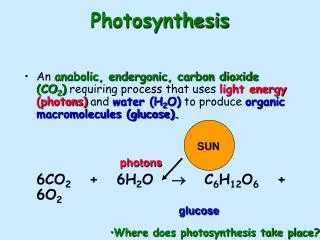
Net Equation for Photosynthesis 6 CO2 + 6 H2O C6H12O6 + 6 O2 light, enzymes