Understanding Factoring, Radicals, and Exponents in Algebra
This guide explains the fundamentals of factoring polynomial expressions, focusing on finding the greatest common factor (G.C.F.) by analyzing both numerical coefficients and variable degrees. It also covers the concepts of radicals and exponents, detailing how to express repeated multiplication as powers. Key distinctions, such as the difference between ((-3)^2) and (-3^2), are emphasized for clarity. Practice problems are provided to reinforce learning, aimed at boosting proficiency in algebraic concepts.

Understanding Factoring, Radicals, and Exponents in Algebra
E N D
Presentation Transcript
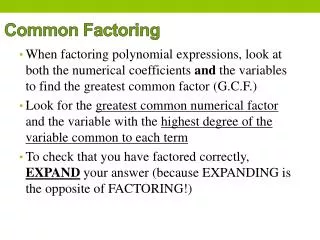
Common Factoring • When factoring polynomial expressions, look at both the numerical coefficients and the variables to find the greatest common factor (G.C.F.) • Look for the greatest common numerical factor and the variable with the highest degree of the variable common to each term • To check that you have factored correctly, EXPAND your answer (because EXPANDING is the opposite of FACTORING!)
Example 2: Factor. a) b) c)
Radicals and Exponents • A radical is a root to any degree E.g. is a squared root, is a cubed root. • A repeated multiplication of equal factors (the same number) can b expressed as a power Example: 3 x 3 x 3 x 3 = 34 34is the power 3 is the base 4 is the exponent
Radicals and Exponents 53 = “5 to the three” 64 = “six to the four” Hizzo = “H to the Izzo”
Radicals and Exponents 63 = 6 x 6 x 6
Radicals and Exponents 52 x 55 = (5 x 5) x (5 x 5 x 5 x 5 x 5) = 57
Radicals and Exponents 68 65 = = = 63
Radicals and Exponents = (72) x (72) x (72) = (7 x 7) x ( 7 x 7) x (7 x 7) = (7 x 7) x ( 7 x 7) x (7 x 7) = 76
Radicals and Exponents = (3 x 2) x ( 3 x 2) x (3 x 2) x (3 x 2) = (3 x 3 x 3 x 3) x (2 x 2 x 2 x 2) = (34) x (24)
Radicals and Exponents = x x = =
The Power of Negative Numbers • There is a difference between –32 and (–3)2 • The exponent affects ONLY the number it touches So, –32= –(3 x 3), but (–3)2 = (–3) x (–3) = –9 = 9
Homework p. 399 # 1 – 3, 5 – 11 (alternating!) Challenge Pg. 401 #16 – 18