Computer Organization
Learn about different levels of computer languages, virtual machines, hardware vs. software, and key milestones in computer architecture. Explore the evolution from mechanical computers to VLSI integrated circuits.

Computer Organization
E N D
Presentation Transcript
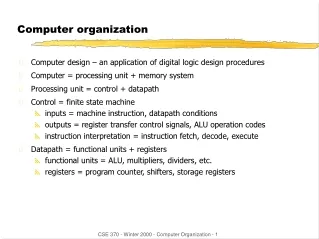
Computer Organization Introduction to Multilevel Machines
Summary • Programs • L1 vs. L2 Languages • Virtual Machines • Hardware vs. Software • Milestones in computer architecture • Assignment
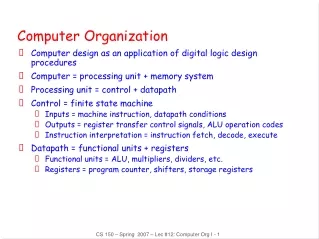
Programs • A sequence of simple instructions describing how to perform a certain task • Together these simple, primitive instructions form a language • People can communicate with the machine using this machine language
L1 vs. L2 Languages • L1: Machine level 1 • Simple language (0’s and 1’s) • Tedious to use: 1110 1001 1110 0111 1001 1000 • Generate new language: L2 • more convenient, easier to use JMP E798 … E798 ADD …
Executing L2 programs on L1 machine • Translation • Replace each L2 instruction with an equivalent sequence of L1 instructions • Computer sees only L1 instructions • Interpretation • Write an L1 program to read L2 programs and execute a sequence of L1 instructions • Translation “on the fly”
Virtual Machines • Stop thinking about Translation or Interpretation • Imagine a virtual machine whose machine language is L2 • L1 and L2 cannot be “too different.” • L2 is better for people to think about than L1 • Still far from ideal • Form language L3 which is still better than L2 for people
Hardware vs. Software • Hardware: electronic circuits, printed circuit boards, cables, power supplies, memories • Software: algorithms, their representations • Firmware: software embedded in electronic devices during their manufacture
Hardware & Software are logically equivalent • Any operation performed in software can be mapped into hardware • Any operation performed by hardware can be simulated in software • Hardware executes faster • Software is more easily modified and less expensive
Milestones in computer architecture • Mechanical computers • Vacuum tubes • Transistors • Integrated Circuits (IC’s) • VLSI (Very Large Scale Integration)
Outside reading material http://www.reprise.com/host/electricity/default.asp http://web.archive.org/web/20020221211122/http://www.owlnet.rice.edu/~engi202/electricity.html http://jersey.uoregon.edu/vlab/Voltage/