
SlideServe
Menu
Préférences
© SlideServe · v2026

Analyzing the Net Reproductive Rate of Field Mice: Survival and Breeding Patterns

ziazan avatar
39 diapositives · 639 Views · Aug 08, 2014

This study investigates the net reproductive rate (Ro) of a cohort of field mice, taking into account survival rates and breeding outcomes. In this population, 50% of females survive to breed at 1, 2, and 3 years old, producing three offspring each time. The calculations for lx (survival proportion) and mx (offspring per survivor) lead to the determination of Ro, highlighting crucial aspects of population dynamics. Additionally, the implications of logistic growth models and natural population variations are discussed, emphasizing the complexity of ecological interactions.
Analyzing the Net Reproductive Rate of Field Mice: Survival and Breeding Patterns - slide 1
01 / 39Analyzing the Net Reproductive Rate of Field Mice: Survival and Breeding Patterns
1 / 17

Télécharger la présentation

Analyzing the Net Reproductive Rate of Field Mice: Survival and Breeding Patterns
Une image / un lien ci-dessous est fourni (tel quel) pour télécharger la présentation

Politique de téléchargement : le contenu du site vous est fourni TEL QUEL pour votre information et votre usage personnel ; il ne peut être vendu, concédé sous licence ni partagé sur d’autres sites sans l’accord de son auteur.Le contenu vous est fourni TEL QUEL, pour votre information et votre usage personnel uniquement. Téléchargez la présentation en cliquant sur ce lien. Lors du téléchargement, si vous ne parvenez pas à télécharger une présentation, l’éditeur a peut-être supprimé le fichier de son serveur.Pendant le téléchargement, si vous ne parvenez pas à obtenir une présentation, le fichier a peut-être été supprimé par l’éditeur.

F I N

Plus de contenu associé

Transcription de la présentation
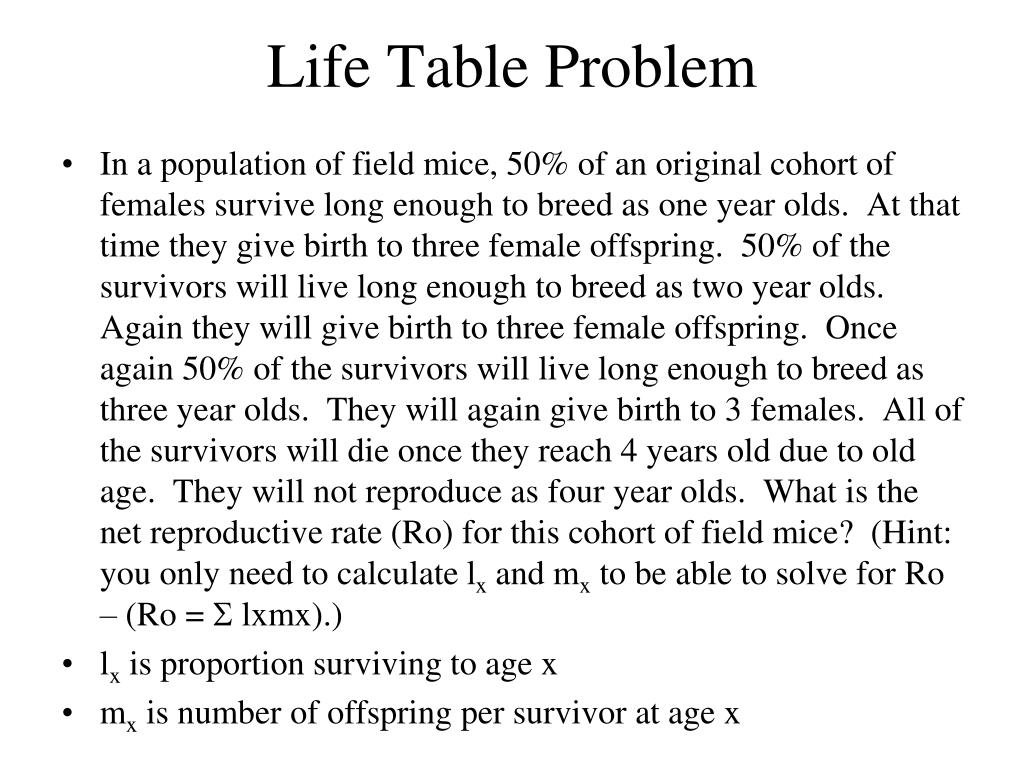
  1. Life Table Problem • In a population of field mice, 50% of an original cohort of females survive long enough to breed as one year olds. At that time they give birth to three female offspring. 50% of the survivors will live long enough to breed as two year olds. Again they will give birth to three female offspring. Once again 50% of the survivors will live long enough to breed as three year olds. They will again give birth to 3 females. All of the survivors will die once they reach 4 years old due to old age. They will not reproduce as four year olds. What is the net reproductive rate (Ro) for this cohort of field mice? (Hint: you only need to calculate lx and mx to be able to solve for Ro – (Ro =  lxmx).) • lx is proportion surviving to age x • mx is number of offspring per survivor at age x

  2. Population Growth Models

  3. Assumptions for logistic growth equation 1. The population initially has a stable age distribution – the SAD assumption. 2. The density of the population has been measured in the proper units. - have we included all age or size classes? 3. The relationship between density and the rate of increase is linear. – each individual has same effect on r. 4. The depressive influence of density on the rate of increase operates instantaneously without any time lags.

  4. Wildebeest

  5. Salix cinerea

  6. Logistic Growth in Several Species

  7. Reasons natural population growth may not fit logistic growth models 1. In nature, each individual added to the population does not cause an incremental increase to r 2. In nature, there are often time lags in growth, especially in species with complex life cycles - mammals may be pregnant for months before giving birth 3. In nature, K may vary seasonally or with climate 4. In nature, often a few individuals command many matings 5. In nature, there are few barriers preventing dispersal

  8. Daphnia magna – with developing embryos

  9. General rules about population growth 1. There is a strong correlation between size and generation time in organisms such that small organisms have shorter generation times than large organisms - this is true for organisms from bacteria to whales  2. Organisms with longer generation times have lower per-capita rates of population growth  3. Therefore, larger animals have lower rates of increase, r. For any given size, endotherms have a higher rate of increase than do ectotherms, which in turn have a higher rate of increase than do unicellular organisms

  10. Competition

  11. Competition Competition is an interaction between individuals, brought about by a shared requirement for a resource in a limited supply, and leading to a reduction in the survivorship, growth, and/or reproduction of the competing individuals

  12. Competition

  13. Competition

  14. Competition Two key points: • Resource being competed for must be limited in supply 2. Interaction is always negative

  15. Competition Intraspecific competition - competition between members of the same species - thought to be especially strong because members of the same species have the same resource requirements – regulates population size Interspecific competition - competition between members of different species - can be very strong as well – also regulates population size, structures communities, influences natural selection

  16. Mechanisms of Competition 1) exploitation competition (aka resource or scramble) - individuals exert negative influence on each other by using up resources that each need - competition is mediated indirectly through resource depletion - individuals don't need to come into contact to compete 2) interference competition (aka contest competition) - competitors directly interact with each other in the course of seeking a common resource

  17. Coral reef community – Great Barrier Reef

  18. Competitive Asymmetries • Although competition has negative effects on the population as a whole, some individuals are more negatively effected than others

  19. Flax

  20. Orchard Grass

  21. Territoriality • Territoriality occurs when there is an active interference such that a more or less exclusive area, the territory, is defended against intruders by a recognizable pattern of behavior - individuals or groups are spaced out more than would be expected from a random occupation of suitable habitats

  22. Golden-winged sunbird

  23. Limpet – Patella cochlear

  24. Patella grazing on crustose algae (A)

  25. Patella Limpet grazing exclusion

  26. Corn

  27. Law of Constant Final Yield