Download
1 / 19
190 likes | 296 Vues
This science fair project investigates the Stroop Effect, which explores how quickly individuals can read words versus naming colors. We hypothesize that people will read words faster than they can name colors, leading to longer response times with mixed color-word lists. We conducted an experiment by testing 10 participants on their ability to identify colors from a list of words printed in conflicting colors. Our analysis and data reveal insights into the cognitive processes involved in reading and perception, with real-life applications in proofreading and reading comprehension.

E N D
PURPOSE: Purpose: Do we want it to be all capital letters?
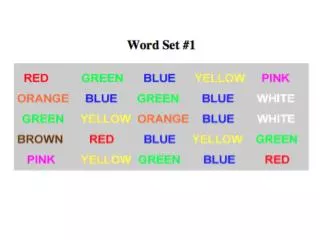
Look at the following four letters: tree. If you are like most people, it is difficult for you not to quickly read the word tree. Most humans are so good at reading, at perceiving WHOLE words, that they do not easily notice the individual letters. This is call the Stroop Effect, named after J. R. Stroop(he was the first to test this theory).
Based on this research, I think that the mind will read the words faster than it will name the colors. Because of this, I think the majority of people will take longer to read the list with the mixed up words and colors than the list with the same colors and words.
1. Make a list of colors written using different color ink. 2. Test 10 people by having them say the colors of the words (not the words themselves) in under a minute. Do not tell them the purpose of the test beforehand. 3. Record how many times the word was said instead of the color of font.4. Make a table of the results.
ANALYSIS: and DATA:
Ever missed misspelled words while proofreading? This explains why it is so hard. Humans have a tendency to quickly read words. This can also cause people to misread words, because the mind works quick and recognizes it as a different word.
PurposeResearch(including websites) HypothesisExperimentAnalysis (graphs, tables, and data)Conclusion Can also include Materials, Procedure, Variables, Real Life Application,