Early Induction of Apoptosis in Z-138 Cells Following ATL Treatment
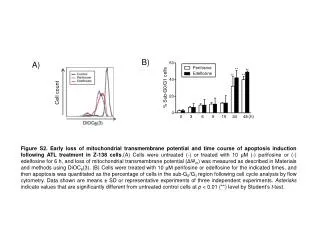
This study examines the early loss of mitochondrial transmembrane potential and the time course of apoptosis induction in Z-138 cells treated with ATL. Cells were either untreated or exposed to 10 μM perifosine or edelfosine for 6 hours. The ΔΨm was assessed using DiOC6(3). Additionally, apoptosis was quantified as the percentage of cells in the sub-G0/G1 region via flow cytometry after treatment with perifosine or edelfosine for varying durations. Significant differences from untreated controls were determined by Student’s t-test (p < 0.01).

Early Induction of Apoptosis in Z-138 Cells Following ATL Treatment
E N D
Presentation Transcript
B) A) ** ** ** ** Cell count (h) Figure S2. Early loss of mitochondrial transmembrane potential and time course of apoptosis induction following ATL treatment in Z-138 cells.(A) Cells were untreated (-) or treated with 10 μM (-) perifosine or (-) edelfosine for 6 h, and loss of mitochondrial transmembrane potential (ΔΨm) was measured as described in Materials and methods using DiOC6(3). (B) Cells were treated with 10 μM perifosine or edelfosine for the indicated times, and then apoptosis was quantitated as the percentage of cells in the sub-G0/G1 region following cell cycle analysis by flow cytometry. Data shown are means ± SD or representative experiments of three independent experiments. Asterisks indicate values that are significantly different from untreated control cells at p < 0.01 (**) level by Student’s t-test.