A novel ant-based clustering algorithm using the kernel method
This study introduces a novel ant-based clustering algorithm incorporating kernel methods to address inefficiencies in traditional distance-based clustering techniques, particularly those affected by non-linear separation boundaries. By utilizing Kernel Principal Component Analysis (KPCA) to refine random projections and enhance distance calculations, this algorithm improves clustering performance on complex datasets with non-Gaussian distributions. The methodology, including parameter settings and evaluation metrics like F-measure and Dunn Index, demonstrates significant improvements in clustering quality and algorithm efficiency.

A novel ant-based clustering algorithm using the kernel method
E N D
Presentation Transcript
A novel ant-based clustering algorithm using the kernel method Lei Zhang*, Qixin Cao 2011, InfSci Presented by Chien-Hao Kung 2011/10/6
Outlines • Motivation • Objectives • Methodology • Experiments • Conclusions • Comments
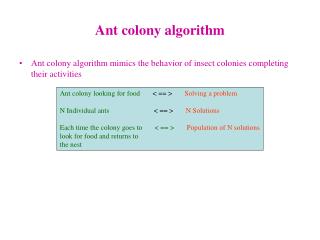
Motivation • Ant-based clustering is not highly efficient because of the randomness in the algorithm. • Ant-based clustering algorithms are distance-based, if the separation boundaries between clusters are nonlinear, however, the algorithms will fail.
Objectives • There are two aspects to the integration. • Kernel principal component analysis(KPCA) is applied to modify the random projection of objects. • To use kernel function calculated the distance between the objects in input space as a similarity measure.
Methodology Grid Object Ant The ant-based clustering algorithm
Methodology • Kernel-based clustering • Mercer kernels • Commonly used kernel functions • Kernel-based clustering
Methodology Enlarging Rounding Shifting • The novel ant-based clustering with the kernel method(ACK)
Methodology • Parameter setting • Size of the projection plane • Radius r • Kernel size • Scaling parameter • Threshold
Experiments • Evaluation functions • The F-measure (F) • The Dunn Index (DI) • The inner cluster variance (ICV) • The error rate (ER) • Time cost (T)
Experiments Experimental data
Conclusions • The algorithm has some new characteristics • The algorithm can deal with some datasets with non-Gaussian distribution because of the incorporation of the kernel function. • The projection based on KPCA creates rough clusters, which reduces the running time and increases the algorithm’s efficiency. • Performing clustering in the feature space after kernel mapping can improve clustering quality.
Comments • Advantages • The paper has some wrong. Application • Ant-based clustering