

SlideServe
Menu
Préférences
© SlideServe · v2026

Summary of Topic 2

zocha avatar
6 diapositives · 268 Views · Oct 22, 2014

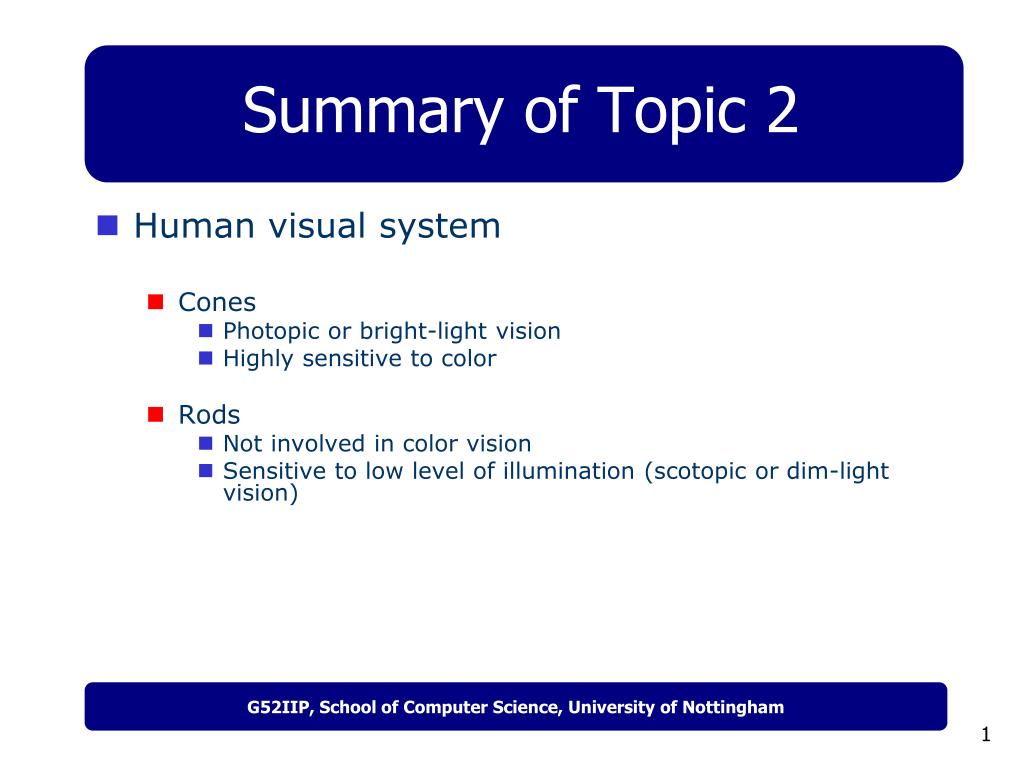
Summary of Topic 2. Human visual system Cones Photopic or bright-light vision Highly sensitive to color Rods Not involved in color vision Sensitive to low level of illumination (scotopic or dim-light vision). Summary of Topic 2. Human visual system Brightness adaptation
Summary of Topic 2 - slide 1
01 / 6Summary of Topic 2
1 / 17

Télécharger la présentation

Summary of Topic 2
Une image / un lien ci-dessous est fourni (tel quel) pour télécharger la présentation

Politique de téléchargement : le contenu du site vous est fourni TEL QUEL pour votre information et votre usage personnel ; il ne peut être vendu, concédé sous licence ni partagé sur d’autres sites sans l’accord de son auteur.Le contenu vous est fourni TEL QUEL, pour votre information et votre usage personnel uniquement. Téléchargez la présentation en cliquant sur ce lien. Lors du téléchargement, si vous ne parvenez pas à télécharger une présentation, l’éditeur a peut-être supprimé le fichier de son serveur.Pendant le téléchargement, si vous ne parvenez pas à obtenir une présentation, le fichier a peut-être été supprimé par l’éditeur.

F I N

Plus de contenu associé

Transcription de la présentation
  1. Summary of Topic 2 • Human visual system • Cones • Photopic or bright-light vision • Highly sensitive to color • Rods • Not involved in color vision • Sensitive to low level of illumination (scotopic or dim-light vision)

  2. Summary of Topic 2 • Human visual system • Brightness adaptation • Subjective brightness is a logarithmic function of the light intensity incident on the eye • The HVS cannot operate on the full perceptible brightness range (~10 orders of magnitude) simultaneously • The total brightness range the HVS can discriminate simultaneously is rather small in comparison (about 4 orders of magnitude) • It accomplishes this through (brightness) adaptation

  3. Summary of Topic 2 • Human visual system • Brightness discrimination • Perceivable changes at a given adaptation level • Weber ratio, DI/I, where I is background, DI intensity change • Small Weber ratio - good discrimination • Larger Weber ratio - poor discrimination • Perceived brightness is not a simple function of intensity • Mach band pattern • Simultaneous contrast

  4. Summary of Topic 2 • A simple image model • Sampling • Quantization

  5. Summary of Topic 2 • Colour image • The RGB Color Model • R, G, B at 3 axis ranging in [0 1] each • Gray scale along the diagonal • If each component is quantized into 256 levels [0:255], the total number of different colors that can be produced is (28)3 = 224 =16,777,216 colors. • The YIQ Color Model • Video (NTSC) standard • Y encodes luminance; I and Q encode chrominance (“color”) • Black and white TV shows only the Y channel • Backward compatibility; efficiency • YCbCr

  6. Summary of Topic 2 • Colour image representation