Catastrophic Events
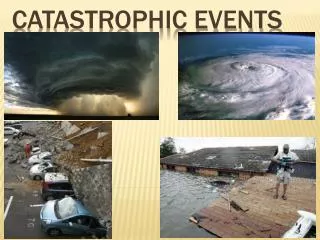
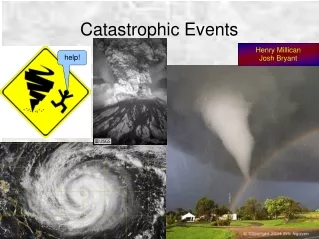
Catastrophic events can cause significant destruction and loss of life. Hurricanes are massive, slowly-spinning tropical storms with strong winds that form over water, leading to storm surges that inundate coastlines. Tornadoes are rapid, whirling storms over land, while tsunamis are giant ocean waves triggered by seismic activity. Earthquakes shake the ground due to fault movement, and volcanic eruptions force materials from below the Earth’s surface. Other events include avalanches, floods, and droughts, all of which have severe implications for communities and ecosystems.

Catastrophic Events
E N D
Presentation Transcript
Hurricane A huge, slowly-spinning tropical storm with strong winds that forms over water.
https://www.valdosta.edu/finadmin/safety/images/Hurricane_formation.gifhttps://www.valdosta.edu/finadmin/safety/images/Hurricane_formation.gif
Storm Surge • A rush of water caused by high winds pushing the ocean's surface above sea level.
Tornado • A small, destructive, whirling, fast-moving storm that forms over land.
Tsunami • A giant, dangerous ocean wave triggered by another event, such as an earthquake or volcanic eruption.
Earthquake • The shaking of the Earth's surface caused by movement along a fault.
Volcanic Eruption • An event in which earth materials are pushed up the vent of a volcano by pressure.
http://www.earthmountainview.com/volcano_cleveland_plume.jpg
Underwater Volcano • http://videos.howstuffworks.com/discovery/7162-underwater-volcanoes-video.htm
Avalanche • A large mass of snow, ice, earth, rock, or other material in swift motion down a mountainside or over a cliff.
Flood A rising and overflowing of a body of water.
Drought • A condition in which there is little or no precipitation.