Download
1 / 16
160 likes | 282 Vues
Fertilization occurs in the female’s fallopian tube, where the sperm and egg nuclei combine to form a zygote. This fertilized cell travels to the uterus, where it implants into the uterine wall, marking the beginning of embryonic development. Prenatal care is essential for monitoring both the mother's health and the baby's growth, providing vital nutrients and reducing risks associated with alcohol and tobacco use. Early and regular doctor visits help ensure a healthy pregnancy and are key to preventing complications such as fetal alcohol syndrome or stillbirth.

E N D
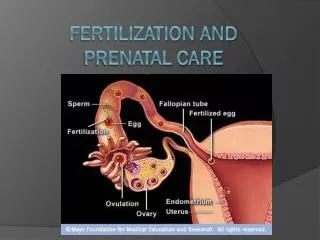
Fertilization • After fertilization in the female's fallopian tube, the nuclei of the sperm and egg fuse to form a new cell (the zygote). A fertilized ovum is called a zygote. • Once a sperm has fertilized the ovum a film immediately surrounds the zygote to prevent other sperm from penetrating. • Remaining Sperm die. • Usually takes place in the Fallopian Tubes
Fertilization Continued… • After being fertilized the zygote then travels to the uterus to implant it’s self in the uterine wall. • Some occasions, an ectopic pregnancy may occur, which means the implantation of the zygote occurred outside the uterus. • The most common site is within a Fallopian tube, however, it can occur: • Ovary • Abdomen • the lower portion of the uterus (the cervix).
Days 3 to 4 • This cell contains 46 chromosomes, 23 from each parent cell. • As the zygote travels to the uterus, it divides, forming a cluster of cells (morula) by about 3 days after fertilization. • The morula develops a cavity and is now known as a blastocyst, which will become the embryo.
Days 4 to 5 • Cell prepares itself to be implanted into the lining of the uterus • Endometrium becomes thick and spongy to prepare for implantation. • Within the cell cover of the blastocyst's cavity, it then develops into a fluid- filled sac covering the embryo, and the yolk sac.
Days 7 to 8 • The blastocyst is completely imbedded into the endometrium, and forms the placenta. • Now the cell is called the embryo. • About the size of the dot over an i • Cells divide until three layers for baby’s organ. • The outer layer grows into the baby's skin and nerves. • The middle layer grows into cartilage, bones, connective tissues, muscles, the circulatory system, kidneys, and sex organs. • The inner layer grows into the organs of breathing and digestion. At 22 days the baby's heart begins to beat.
The Embryo, Placenta, and Umbilical Cord
Definitions • Amnion – (bags of water) membrane that forms around the developing embryo • Acts as a shock absorber to protect embryo. • Placenta- Forms along the lining of the uterus. • Blood enriched tissue that transfers oxygen and nutrients from mother’s blood • Serves as lungs, liver, kidneys, endocrine glands, and digestive system for the developing embryo. • Blood of the mother and embryo never mix. • So body will not reject baby as foreign organism. • Oxygen, nutrients, and waste “pass through” • Umbilical Cord – made up of blood vessels • About 20 inches in length • Connects placenta to mother’s blood vessels
Definitions Continued…… • HCG (Human Chorionic Gonadotropin)- Secreted by the placenta • Stimulates production of estrogen and progesterone. • Helps maintain lining of the uterus. • Prevents ovulation from occurring.
Determining Pregnancy • Doctor’s Office / Lab • Check for HCG • Present in the mother’s urine. • Detectable as early as one week after first missed period • Radioimmunoassay • Can detect HCG up to one week before period is to begin. • Internal Examination • Cervical Changes • Size of the uterus
Determining Pregnancy Cont…. • Home Pregnancy Tests • Measures HCG • “Negatives” tend to be less reliable than “Positives”
Prenatal Care • Doctor’s Visit • As soon as possible • Dr. does internal as well as blood • Monitors baby’s development • Monitors mothers health behaviors • Eating habits and vitamins discussed. • Fetal Alcohol Syndrome • Can cause physical, mental, and behavioral abnormalities • Babes are shorter and lighter • Impaired Speech • Mental Retardation • Hyperactivity • Poor Conditiion
Fetal Alcohol Syndrome • Can Cause birth defects • Cleft Palate • Facial Abnormalities • Heart Defects • Alcohol drunk by the mother is passed directly to the baby • Baby can become drunk • Can be born addicted to alcohol • Baby cannot rid itself of alcohol for a long period of time • Where does the alcohol pass through to the baby??????
Smoking • Greater chance of premature birth • Lower birth rate • Smokers are 2 times more likely to have a miscarriage or stillbirth • Both stillbirth and miscarriage are types of pregnancy loss, but they differ by when the loss occurs. • A miscarriage(sometimes called a spontaneous abortion) is when a baby dies before the 20th week of pregnancy. • Stillbirth is the death of a baby after the 20th week of pregnancy but before delivery. • Also at risk from passive smoking. • Each year in the United States about 25,000 babies, or 68 babies every day, are born still.
Responsibility of the Mother • Get prenatal care early. Go to all your regularly scheduled doctor appointments. • Eat a well-balanced diet. Continue to take a multivitamin to be sure that mother and baby both get the nutrients they need. • Gain enough weight, but not too much. • Money
Costs of Having a Baby • The costs of raising a baby to age 18 costs between $125,000-$250,000 and that's not including college tuition! • In your baby's first year alone, you can easily spend between $9,000-$11,000 • diapers, formula, baby furniture, clothing, baby gear, etc. • Two things that can save you money right off is deciding to use cloth diapers, using 2nd hand items and breastfeeding.