Ground Flora Study: Monitoring Effects of Forest Management on Biodiversity
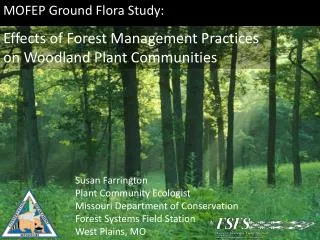
The MOFEP Ground Flora Study Team, consisting of experts like Jenny Grabner and Randy Jensen, aims to investigate ground flora species diversity, composition, and richness under varying forest management treatments. Key findings reveal that pre-treatment biodiversity was rich with over 530 species, but post-treatment showed a decrease in species richness on no-harvest sites. The study highlights the importance of geological and soil factors affecting ground flora. Future research needs include additional sampling and species analysis to better understand forest management impacts.

Ground Flora Study: Monitoring Effects of Forest Management on Biodiversity
E N D
Presentation Transcript
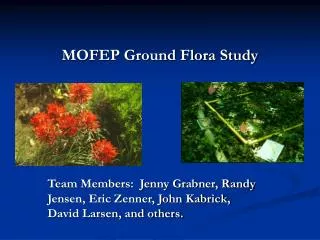
MOFEP Ground Flora Study Team Members: Jenny Grabner, Randy Jensen, Eric Zenner, John Kabrick, David Larsen, and others.
Project Goals • Determine pre-treatment differences among sites, treatments, and blocks with respect to: • ground flora species, plot diversity, and plot richness. • Detect patterns in the ground flora data in relation to environmental conditions both within and among sites. • Document changes in ground flora vegetation following even-age, uneven-age, and no-harvest management.
Key findings: Pre-treatment • 530+ different species, including 275 genera in 85 families • > 50% of species on less than 10% of the 648 plots • Plots averaged high species diversity • low and high species richness and species diversity within plots of all sites • species composition and abundance, and plot richness and diversity were dependent on: • geology, landform, and soils, within and among sites
Key findings: Post-treatment • species richness decreased on no-harvest sites but increased slightly on even-age and uneven-age sites • ground cover (%) increased on all sites and treatments but harvested sites increased more than no-harvest sites • annual / biennial species increased increased the most on even-age management sites: • The post-treatment relative cover (%) was 1% or less on all sites • relative cover (%) of woody vines increased the most on the even-age and uneven-age sites • legumes decreased significantly on harvested sites but increased slightly on no-harvest sites
Ground flora richness difference Even-aged Uneven-aged No-harvest Group openings Single-tree selection Uncut Intermediate cuts Clearcuts Uncut
% Ground cover difference Even-aged Uneven-aged No-harvest Group openings Single-tree selection Uncut Intermediate cuts Clearcuts Uncut
Past Challenges • Lots of quadrats (10,368) to sample in a short time. • Lots of data and lots of species to analyze. • Lots of plant taxonomy training and a learning curve through the years. • Treatments, sites, elts, new elts, eltps, soils, cut or not cut – how to put it all together
Research Needs • A botanist on MOFEP ! • Determining the number of years sampling is required before and after the next 2011 harvest. • Is an additional sampling design desired to detect differences of forest management on rare species? • A quadrat level treatment header for the difference between single-tree and group selection harvests. • Individual species analysis. • Better understanding of how scale and patch dynamics affects forest ground flora.
Future Plans ???