MONTANA UPDATE
Montana's fish habitats face significant challenges including ineffective screen laws, barriers to fish passage, and a lack of specific funding. The Upper Big Hole River is critical for the last fluvial arctic grayling population in the U.S., while the Yellowstone River's diversion dams hinder access for numerous warm-water species. Efforts like the Candidate Conservation Agreement aim to reduce fish entrainment. Various fish screens and passage projects, though lacking centralization, are being implemented to protect both native and non-native trout species, ensuring biodiversity and ecological integrity.

MONTANA UPDATE
E N D
Presentation Transcript
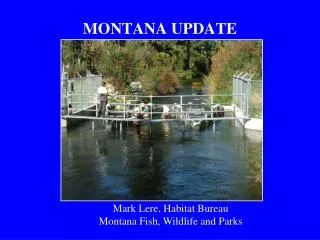
MONTANA UPDATE Mark Lere, Habitat Bureau Montana Fish, Wildlife and Parks
WHAT WE DON’T HAVE • SCREEN LAWS • SCREEN SHOPS • SPECIFIC FUNDING (Mitchell Act) • ANADROMOUS FISH • NMFS OVERSIGHT
WHAT WE DO HAVE • SOME NEEDS! A FEW EXAMPLES….
UPPER BIG HOLE RIVER • Home to the last fluvial arctic grayling population in the contiguous United States • Has very robust Candidate Conservation Agreement with Assurances Program • One main goal of the CCAA is to eliminate entrainment into irrigation systems • Supports traditional agriculture – most rely on flood irrigation for hay crops, thus numerous diversions Photo by Mark Conlin
Miles City T & Y Diversion (Rm 20.4) Map of the Yellowstone River, tributaries, and diversion dams with approximate river miles (Rm). YELLOWSTONE RIVER • Series of 6 low head diversion dams • Hinder or block upstream fish passage for numerous warm water species of fish, including pallid sturgeon , paddlefish, sauger, blue sucker………. • The diversions entrain lots of fish
INTAKE DIVERSION • 1,300 cfs diversion • Passage barrier to most fish species • Entrainment estimates for Intake diversion range from 50,000 to 350,000 fish per month • Recently screened, but passage remains a BIG issue
BULL TROUT & CUTTHROAT TROUT • Losing native trout species to entrainment • Losses commonly not well quantified • Diversions typically have not been prioritized • Most screen and passage projects are opportunity based • Federal strings occasionally drive projects
NON-NATIVE SPORT FISH • Also have concerns about entrainment of our non-native sport fish • Typically rainbow trout and brown trout
WHAT WE ARE DOING - SCREENS • Installed a variety of screens • Infiltration galleries • Simple passive horizontal screens • Passive inclined plane screens • Turbulent fountains • FCA screens • Rotary drum screens • Vertical flat plate screens • Traveling belt screens • Efforts not centralized • Not all meet NMFS criteria
FISH SCREENS • Scale of Screen Projects • From small to very large • A majority of our installed screens are around 20 cfs or less.
WHAT WE ARE DOING – FISH PASSAGE • Many passage projects completed across the state • From projects for our stronger swimming and jumping fish in the west • To our weak swimming, non-jumping fish in the east
WHAT WE ARE DOING - BARRIERS • At times, it appears that we have a split personality disorder • Migration barriers are being used to isolate our native cutthroat trout from non-natives (rainbow trout, brook trout, and brown trout)