Understanding Projections: Orthographic and Perspective Transformations in 3D
This document explores the concepts of projections in mathematics, particularly orthographic and perspective transformations. Projections are defined as the mapping of 3D points onto a 2D plane, highlighting differences between these approaches, such as how they handle parallel lines and the appearance of objects at varying distances. The text delves into the mathematical principles behind projections, including the properties of orthographic and perspective projections, vanishing points, and the view frustum concept. It emphasizes how perspective can alter our perception and understanding of 3D space.

Understanding Projections: Orthographic and Perspective Transformations in 3D
E N D
Presentation Transcript
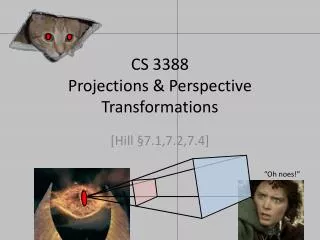
CS 3388Projections & Perspective Transformations [Hill §7.1,7.2,7.4] “Oh noes!” TexPoint fonts used in EMF. Read the TexPoint manual before you delete this box.: AAAAAAA
Projections • A projection is the image of something, rather than the thing itself • Mathematically, transformation fis a projection if f(p)=f(f(p)) for all p2Rn • Or, P2Rn£n is a projection if P2´P • Q: what is the only invertible ‘projection’? 3D thing pinhole camera 2D image of thing nautilus eye http://pixdaus.com/single.php?id=187022 http://en.wikipedia.org/wiki/File:Pinhole-camera.svg
Orthographic Projection • Project 3D points onto plane (2D image): • Projection lines orthogonal to the projection plane projection lines y projected points z x projection plane
Perspective Projection • Project 3D points onto plane (2D image): • Projection lines pass through center; not orthogonal to projection plane projection lines y projected points z x center of projection projection plane
Properties of Projections i.e.f(p)=p • Many points project to same location • projection not invertible, i.e. can have f(p)=f(q) • point p in projection plane projects to p, i.e. f(p)=p • Orthographic: • parallel 3D lines project to parallel 2D lines • Perspective: • 3D lines project to 2D lines (parallel not preserved) • further objects appear smaller
Perspective Foreshortening • Projection p0=f(p) appears closer to center line as p gets further from plane Q: how far must we travel along this line to ‘hit’ vanishing point? same x in 3D different x0 in 2D x causes lines parallel in 3D to converge to a vanishing point z
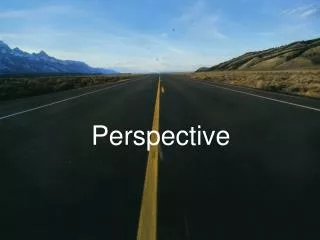
Vanishing Points lines parallel in 3D may converge in perspective x Each 3D orientation has its own vanishing point, ... z ... but what family of lines stays parallel even in perspective? two vanishing points http://www.mymodernmet.com/profiles/blogs/flatiron-building-in-ny-will
Your Brain Needs Perspective! different projected size same projected size “Ames room” http://www.flickr.com/photos/leolondon/490312841/ http://www.flickr.com/photos/gandhiji40/399633119/ http://www1.appstate.edu/~kms/classes/psy3203/Depth/AmesDiagram.htm http://www.psychologie.tu-dresden.de/i1/kaw/diverses%20Material/www.illusionworks.com/html/ames_room.html
Your Brain Needs Perspective! http://www.impactlab.net/2006/03/09/amazing-3d-sidewalk-art-photos/
Canonical View Frustum • We “look” down negativez axis • Only “see” 3D objects inside view frustum (DirectX flips z axis!) view frustum (bounded volume) y center of projection (eye / camera) z x near rectangle near plane far plane (left,top) (right,bottom) (z = small constant) (z = large constant) project 3D objects onto 2D near plane!
Canonical View Frustum • Orthographic projection is very similar view frustum near rectangle (rectangular prism) (left,top) (right,bottom) y z x far plane z near plane z
*we revisit this later to preserve ‘depths’ 3D ! 2D Projection* • If point is known, what is its projection? • Intersect projection line with near plane! orthographic perspective slide x,y,z slide z only! x x z z warning: book, OpenGL use z=-n, n>0 notice scaling n merely scales the image!
[Hill p.353,354] Alternate View on Perspective • Two conceptual steps: orthographic projection 3D view frustum perspective transformation linear squash non-linear depth stays parallel linear stretch now not parallel =perspective projection x now parallel z
[Hill p365] Taxonomy of Projections planar projection parallel perspective oblique orthographic
Classes of Transformation • “Projective transformations” includes affine + perspective transformations, not projections!! “projective” perspective (new!) “affine” “linear” “rigid-body” scaling rotation translation shearing reflection
Arbitrary View Frustums • What about eye not looking down z axis? • Don’t move frustum, move world! rigid-body transformation boooooAyn Rand projection calculations easy again! x x z z
Arbitrary View Frustums • Assume eye translated by v, rotated by µ back in canonical form! x x z z (we omit y dimension for simplicity)
[Hill §7.2.2] (uses look “point”) Arbitrary View Frustums • In 2D can also specify eye orientation as a look vector • In 3D, look not enough... need up vector look µ x z #include <cmath> // for atan2(y,x) up look controls yaw and pitch up controls roll look y z x