Overview of Eos: Access, Billing, Queue Policy, and Software Documentation
The Eos system features 744 compute nodes, each with 16 physical cores and 64 GB memory, designed to support resource-intensive tasks. Users with INCITE projects benefit from prioritized access, with each project receiving an automatic account. The queue policy allows unlimited running jobs with a two-job limit per user. Eos supports various programming environments including Intel, Cray, PGI, and GNU compilers. Ongoing updates to the documentation ensure users remain informed about known issues and software availability. Eos aims to facilitate efficient computing and data handling.

Overview of Eos: Access, Billing, Queue Policy, and Software Documentation
E N D
Presentation Transcript
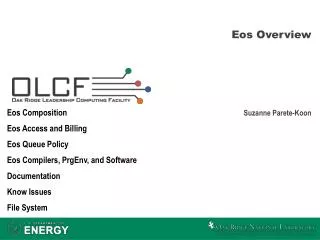
Eos Overview Eos Composition Eos Access and Billing Eos Queue Policy Eos Compilers, PrgEnv, and Software Documentation Know Issues File System Suzanne Parete-Koon
Eos Nodes • 744 compute nodes, 16 physical cores/node, 64 GB/node. • Two NUMA Domains L3 cache = 20 MB • No Accelerators • Hyper threading (32 logical core/node) • 2 External Logins • Total of 11,904 cores and 47.6 TB DDR3 SDRAM
Eos Access and Billing For the remainder of this year: • Eos is prioritized as an extra resource for INCITE users. • All INCITE projects will automatically be given an account on Eos. • 30 Eos core hours are charged per node. • Hours count for Usage • Hours are not subtracted from INCITE Allocation
Eos Queue Policy • Queue Policy • Unlimited running jobs • Limit of (2) eligible-to-run jobs per user. • Jobs in excess of the per user limit above will be placed into a held state, but will change to eligible-to-run at the appropriate time. • Feedback?
Compilers and PrgEnv • Our programming environment modules will load the correct pairing of compiler version, message passing libraries, and other items required to build and run. • Programming environments available PrgEnv-Intel, PrgEnv-Cray, PrgEnv-PGI and PrgEnv-GNU. • Intel is the default compiler and programming environment. Module swap PrgEnv-Intel PrgEnv-Cray • Compiler wrappers ftn, cc,CC still recommended. • Linking is static by default.
Profiling and Debugging • Saleable debugger DDT • ATP • Profiling Craypat, perftools • Papi Hhardware counters • More to come . . .
Software • Early times so we are still updating documentation. In the mean time . . . % module avail (everything) %Module list (just what’s loaded) . . .
Known Issues • cmake with the Intel compiler • Check for working C compiler fails • Adds the –rdynaimc flag and tries unsuccessfully to cross compile. This has been mended in the Module file • However if you still have trouble: • explicitly specify the compiler and then force cmake not to check if that compiler works. This can be done with the -D options when you issue cmake: $ cmake -D CMAKE_CXX_COMPILER=icc -D CMAKE_C_COMPILER_WORKS=TRUE . • cmake works fine with PGI, GNU and Cray compilers.
New Filesystem • New Spider II Filesystem – only mounted on EOS • Data transfer is required for files not in Home or HPSS • Chris Fuson will tell you more