
Punnett Squares
E N D
Presentation Transcript
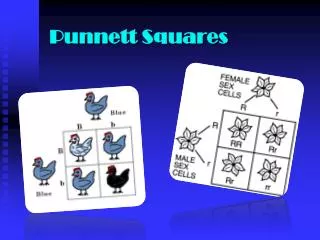
Punnett Squares • The work of Reginald C. Punnett, English mathematician • Predict possible offspring and their ratios from any given cross • Greater the number of results, the closer to the predicted outcome
Punnett Squares • Individuals with identical alleles are called homozygous (TT, tt) • Individuals with different alleles are called heterozygous (Bb) • Phenotype – physical characteristics (brown eyes, can taste PTC, wrinkled seed coats, etc. • Genotype – the actual genes present/genetic makeup (homozygous recessive, homozygous dominant, heterozygous)
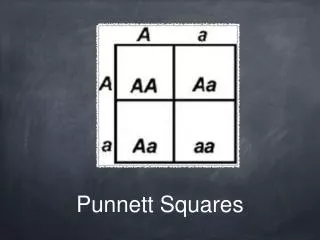
How to use Punnett Squares • Choose a letter to represent the alleles in the cross. (first letter of dominant trait?) • Write the genotypes of the parents. • Determine the possible gametes (reproductive cells) that the parent can produce, containing one gene from each gene pair. • Enter the possible gametes at the top (mom) and side (dad) of the Punnett square.
Bb (heterozygous blue eyed) X Bb B b B b
More Punnett Squares • Complete the Punnett square by combining the alleles from the gametes in the appropriate boxes. • Put pairs together (dominant first) in same order as parents • Determine the genotypes/phenotypes (and their numbers) of the offspring. • Write down the genotypic and phenotypic ratios in simplest form.
Dominant brown eye gene from each B b B BB b
Dominant B from one, recessive b from the other……….(dominant first, please) B b B BB Bb b Bb
Recessive blue eyed gene from each B b B BB Bb b Bb bb
Genotype ratio = 1BB:2Bb:1bbPhenotype ratio= 3 brown eyed:1 blue B b B BB Bb b Bb bb
Try these: • Tt X Tt, where T=taster of PTC, t=nontaster • RrYy X RrYy, where R=round peas, r=wrinkled peas, Y=yellow, y=green