Understanding Price of Anarchy in Cost-Sharing Connection Games
780 likes | 911 Vues
This seminar, supervised by Prof. Michal Feldman at Tel-Aviv University, explores the theoretical framework of connection games in network formation. Agents aim to construct networks to connect various terminals while sharing costs. It delves into general and fair cost-sharing, as well as specific cases like capacities and symmetric scenarios. Key concepts discussed include Nash equilibria, price of stability, and algorithms for efficient payment strategies among players. The insights revealed offer significant implications for network design with selfish agents.


Understanding Price of Anarchy in Cost-Sharing Connection Games
E N D
Presentation Transcript
Network Formation GamesOfir Geri Price of Anarchy Seminar Supervised by Prof. Michal Feldman Tel-Aviv University 2/4/2014
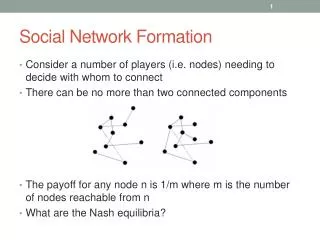
Introduction • We discuss games in which agents wish to construct a network • Each agent has different terminals they wish to connect • The cost of the network is shared between the agents • Each agent may contribute to any link
Outline • General cost-sharing connection games • Fair cost-sharing connection games • Capacitated symmetric cost-sharing connection games
General Cost-SharingConnection Games E. Anshelevich, A. Dasgupta, É. Tardos, and T. Wexler, “Near-Optimal Network Design with Selfish Agents”
The Connection Game • There are players • is an undirected graph • Each player must connect a set of terminals in • An edge has a cost • Each player offers payments • The graph of bought edges is where
Basic Properties of Nash Equilibria • The bought edges form a graph that is a forest • A player only contributes to the edges they use • Each edge is either fully paid for or not paid at all
A Nash Equilibrium May RequireCost-Sharing • NE: Player 2 pays 5 foredge , player 1 pays forthe rest • Any NE must buy edge • Player 2 only contributesto • A non-fractional NEdoesn’t exist
The Price of Anarchy • Lower bound:In this example, • The same holds when theedges are directed and thecosts are shared in a fairmanner
The Price of Anarchy • Theorem: In every connection game with players, • Proof: Let be the worst Nash equilibrium • The cost of each player is at most • If a player pays more than , they can buy instead
Single Source Games • All players share a common source , and player has only one other terminal, • In this class of games, the price of stability is 1
Single Source Games: Price of Stability • Denote by the minimum cost Steiner tree that connects all terminal nodes • Consider as the root • Let be the sub-tree thatis disconnected from ifedge is removed
Single Source Games: Price of Stability • We show a Nash equilibrium that buys • We only need to define the payments
Algorithm 1 • For all players and edges , set • For all edges in in reverse BFS order: • For players so that (until is paid for): • If is a cut in , set • Define: • Define to be the cost of the lowest cost path from to in under • Define • Define • Set
Single Source Games: Price of Stability Claim: The algorithm yields a Nash equilibrium Proof: • At any stage, emulates the cost of the lowest cost path that does use an edge • We set the payment for to be at most the cost of the alternative path to • A player cannot reduce their cost by deviating
Single Source Games: Price of Stability • We only need to prove that the algorithm fully pays for • For each edge , the players with terminals in must pay for • Otherwise, each player has a path that explains why they can’t contribute more to • We show that if is not fully paid for, these paths allow us to find a solution that is better than
Single Source Games: Price of Stability • At some stage, denote by the alternate path that costs for player • Choose the one that includes as many ancestors of in as possible • Lemma: is composed of three sub-paths • The first contains only edges from • The second contains only edges from • The third contains only edges from
Single Source Games: Price of Stability Proof: • Once reaches a node in , it will use nodes from since their cost is 0 • Suppose starts with a path that contains edges of , and continues with a path that contains edges of , leading to node in • Let be the common ancestor of and
Single Source Games: Price of Stability (Figure taken from Anshelevich et al., “Near-Optimal Network Design with Selfish Agents”)
Single Source Games: Price of Stability • We prove that • is strictly below • Otherwise, is contained in • We get that • Since , • is not the best deviation
Single Source Games: Price of Stability • Consider an iteration during which player contributed to an edge in • The total payment of is bounded by the cost of any path, including • After reaches , the rest of the path to costs
Single Source Games: Price of Stability • We proved that • If we replace with in • The cost can only decrease • contains a higher ancestor of than () • Hence, a contradiction!
Single Source Games: Price of Stability • We are ready to prove that the algorithm pays fully for • Suppose that for an edge , • Recall that is the alternative path for • The highest ancestor of in that is also in will be denoted (’s deviation point) • Let be the set of the highest deviation points, such that every has an ancestor in
Single Source Games: Price of Stability • Let be the sub-tree rooted at • Assume all players with deviated to • Payments are notincreased • All edges in every are still paid for (Figure taken from Anshelevich et al.,“Near-Optimal Network Design with Selfish Agents”)
Single Source Games: Price of Stability • Each path connects to • pays fully for the edges that are not in • All terminals are connected to after the deviation • The total cost of all players is less than , but is optimal • Hence, a contradiction!
Approximate Nash Equilibria • Definition:A strategy profile is a -approximate Nash equilibrium if no player can decrease their cost by factor of more than by deviating • Intuitively, we want players not to profit much from deviating
Single Source Games • Finding OPT is NP-Hard • Let be an -approximate minimum cost tree • We present a poly-time algorithm for finding a (1+ε)-approximate Nash equilibrium , so that
Single Source Games Algorithm 2 • Define • Use Algorithm 1 to pay for all edges in , with their cost decreased by • is not optimal, so the algorithm may fail to buy an edge • In that case, construct a tree so that and run Algorithm 1 iteratively
Single Source Games • For each player and for each edge , the final payment is
Single Source Games • Algorithm 1 can be run in polynomial time • Algorithm 1 may run at most times • The run-time of Algorithm 2 is polynomial in and the network size
Single Source Games • All edges are fully paid for • Suppose contains edges • Compared to the Nash equilibrium returned by Algorithm 1, the payments increased in
General Connection Games • The price of stability can be • Every NE must buy a path that costs (Figure taken from Anshelevich et al., “Near-Optimal Network Design with Selfish Agents”)
General Connection Games • We show that there is a 3-approximate Nash equilibrium that pays for • Given a set of edges , a stable payment is a payment such that doesn’t have a profitable deviation, assuming the rest of is bought by the rest of the players • A Nash equilibrium consists of stable payments for all players
Stable Payments • Consider a payment scheme • Theorem: If every payment can be divided into at most payments, such that each of them is a stable payment, then is an -approximate Nash equilibrium
Stable Payments Proof: • Let be the best response of player to • Let be the sub-payments of • is still a possible deviation for • We get , hence
Connection Set: Definition • From now on, a player either pays fully or pays nothing for each edge • A set of edges is a connection set of if for every connected component in we have that either • Any player that has terminals in has all of its terminals in , or • Player has a terminal in
Connection Sets • Lemma: A connection set of player is a stable payment of with respect to • Proof: Let be the best deviation of • is a set of edges so that connects all of ’s terminals • If two terminals of another player are in different components of , they are connected in
Connection Sets • Thus, is a possible solution • is optimal, • Therefore,
3-Approximate Nash Equilibrium • Observe that the set of edges used only by is a connected set, • We want each player to pay for 3 connection sets • will be the first connection set, and from on, assume that all edges are used by at least two players
3-Approximate Nash Equilibrium • Assume is a path • is the set of terminals at • For each terminal ,define a path (Figure taken from Anshelevich et al., “Near-Optimal Network Design with Selfish Agents”)
3-Approximate Nash Equilibrium • A payment that contains one edge from for every terminal of except the last terminal is a connection set (Figure taken from Anshelevich et al., “Near-Optimal Network Design with Selfish Agents”)
3-Approximate Nash Equilibrium • A max-coupled-set is a set of edges such that every is contained in exactly the same paths , for (Figure taken from Anshelevich et al., “Near-Optimal Network Design with Selfish Agents”)
3-Approximate Nash Equilibrium • Let be a max-coupled-setFor all components of except the two end components, any player that has a terminal in has all its terminals in • Suppose has a terminal in • If has a terminal before or after , the edges in adjacent to can’t be in the same coupled-set
3-Approximate Nash Equilibrium • A payment that contains at most one max-coupled-set from for every terminal of except the last terminal is a connection set • If a component does not contain a terminal of , it is bordered by edges of the same max-coupled-set
3-Approximate Nash Equilibrium • Finally, we wish to match at most two connection sets to each player • We form a bipartite matching problem • is the set of all max-coupled-sets • is • There’s an edge between and if there is such that • For players that don’t have a terminal in , form an edge between the last terminal and if
3-Approximate Nash Equilibrium • We use Hall’s Matching Theorem to assign a node to each max-coupled-set • For , denote by the set of nodes that can be connected to • We need to prove
3-Approximate Nash Equilibrium • Sort the edges that are part of • If two edges belong to different max-coupled-sets, there must be a path that contains only one of the edges • The player corresponding to must have a terminal between the two edges • There must be a terminal from before the first edge in
3-Approximate Nash Equilibrium • We have shown that for all • Using the matching, each player can be assigned (at most) two connecting sets • We get a 3-approximate Nash equilibrium • This is expanded by induction to the whole tree
Fair Cost-SharingConnection Games E. Anshelevich, A. Dasgupta, J. Kleinberg, É. Tardos,T. Wexler, and T. Roughgarden, “The Price of Stability for Network Designwith Fair Cost Allocation”
The Fair Connection Game • We consider directed graphs • Each player chooses only which edges to use • We use Shapley (fair) cost-sharing: