Download
1 / 15
160 likes | 295 Vues
The Reuven Ramaty High Energy Solar Spectroscopic Imager (RHESSI) is a NASA Small Explorer mission launched on February 6, 2002. It features a spin-stabilized modulation collimator array in low Earth orbit, using germanium detectors for high-resolution X-ray and gamma-ray imaging spectroscopy. Key contributors included UC Berkeley, NASA GSFC, and the Paul Scherrer Institute. The mission has made significant discoveries, including detailed analyses of solar flares and their interplanetary connections, with all data made publicly available.

E N D
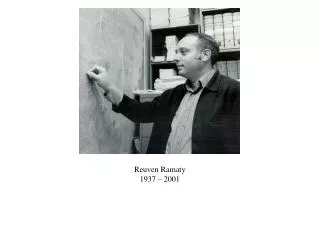
Reuven Ramaty 1937 – 2001
RHESSI people • UC Berkeley (Bob Lin) • NASA GSFC (Brian Dennis) • Paul Scherrer Institute (Alex Zehnder) • Co-Is Benz, Brown, Emslie, Enome, Hudson, Hurford, Kosugi, Ramaty, Smith, Vilmer (Aschwanden? Holman? Krucker?)
RHESSI description • A NASA Small Explorer (the 6th SMEX) • Spin-stabilized modulation collimator array in low Earth orbit • Germanium detectors for high resolution X-ray and g-ray imaging spectroscopy • Launched successfully February 6, 2002 • All data and software public-domain. The GUI really works.
Three RHESSI items • Interplanetary connection • Gamma-ray flare (July 23, 2002) • Late arcade development (April 21, 2002)
Slide 16 Slide 16 Courtesy of Brian Dennis
Centroids of bremsstrahlung and 2.223 MeV emissions Hurford et al. 2003