Blood
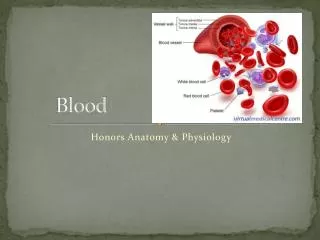
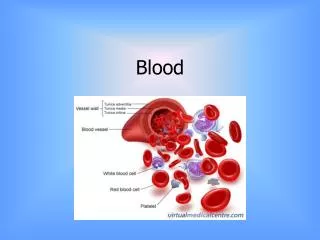
Blood is an essential connective tissue that serves as a supportive fluid in the body, transported through a closed system via blood vessels. It comprises plasma, a liquid portion that contains water, proteins, nutrients, hormones, and electrolytes, alongside formed elements such as erythrocytes (RBCs), leukocytes (WBCs), and platelets. Blood plays critical roles in transportation, regulation, and protection. Erythrocytes carry oxygen, leukocytes defend against infections, and platelets are crucial for clotting. Each component of blood is vital for maintaining overall health and homeostasis.

Blood
E N D
Presentation Transcript
Blood • Essential Life Supportive Fluid • Transported in Closed System Throughout Body Through Blood Vessels • Connective Tissue = Cells + Matrix
Physical Characteristics • Viscous • pH 7.35 – 7.45 • Temperature: 38 degrees C; 100.4 degrees F • 7% - 8% of total body weight • Males: 5 – 6 liters • Females: 4 – 5 liters
Functions of Blood • Transportation • Regulation • Protection
Formed Elements • Erythrocytes: (RBCs) • Leukocytes (WBCs) • Platelets
General Characteristics of Formed Elements • Living blood cells • 2 out of 3 are NOT true cells • Most are short lived • Most do not divide • Hematopoiesis occurs in liver, spleen, thymus, & bone marrow
Plasma • Liquid portion: 90-92% water with fibrous proteins (fibrin) • Straw colored • Clear, sticky fluid
Proteins • Nutrients • Hormones • Electrolytes • Respiratory gases
Functions of Plasma • Suspends blood cells & transports blood cells • Carries metabolic wastes & nutrients • Circulates hormones Maintains water content and body temperature • Maintains acid-base balance of blood
Erythrocytes • Shape: biconcave disc • Spectrin (fibrous protein) flexibility to change shape • Mature anucleate • 4 – 5.5 million per cubic millimeter • Lifespan: 100 – 120 days • 97% is hemoglobin • Erythropoiesis
Leukocytes/WBCs Surveillance, Fighters, Protectors
5 Types of WBCs • Neutrophils: granulocyte • Eosinophil: granulocyte • Basophil: granulocyte • Lymphocyte: agranulocyte • Monocyte: agranulocyte
Neutrophils • Nuclei: 3-6 lobes; polymorphonuclear leukocytes (polys) or segmented neutrophils (segs) • Increase in % bacterial or some fungal infections • Destroy bacteria by phagocytosis • Life span: 0.5 – 9 days
Eosinophil • Nucleus: 2 lobes, large red granules • 1 – 4% of all WBCs • Participate in allergic reactions • Increase in % possible parasitic infection (i.e. flatworms – tapeworms, flukes; roundworms – pinworms, hookworms) or allergic response to antigen-antibody complex • Lifespan: 0.5 – 9 days
Basophils • Large coarse purple granules with histamine (inflammatory chemical that acts as vasodilator & attracts other WBCs to the inflamed site) • Mast cells = similar • Release heparin & histamine • Lifespan: 0.5 – 9 days
Lymphocytes • Nucleus: large, dark purple spherical • Increase in % possible viral infection • T & B cells • Produce antibodies • T cells act directly against virus infected cells & tumor cells • B cells plasma cells antibodies (Ig’s) • Lifespan: a few days to decades
Monocytes • Nucleus: dark purple kidney or U-shaped with gray blue cytoplasm • In tissues become macrophages • Increase in % possible chronic infections i.e. TB & certain viruses & intracellular parasites • Activate lymphocytic immune response • Lifespan: several months
Platelets • Thrombocytes • Involved in blood clotting • Small cytoplasmic fragments from megakaryocyte • 250,000 – 400,000 per microliter • Lifespan: live only 10 days • Aspirin inactivates the platelets