October Team Meeting Overview: T2 LBLOCA Corrosion Results and Bench Experiments
On November 29, 2012, the team, led by Dr. Janet Leavitt, discussed preliminary results from T2 LBLOCA corrosion tests. Key objectives included evaluating aluminum corrosion and its impact on head loss, conducted under specified temperature and chemical conditions. Notable findings included SEM and ICP analysis of scale formed on submerged materials, revealing crystalline and trace phases. The discussion highlighted that aluminum corrosion release into solutions is lower than predicted, suggesting minimal impact on ECCS strainers for breaks under 15 inches. Further test plans focus on refining corrosion research.

October Team Meeting Overview: T2 LBLOCA Corrosion Results and Bench Experiments
E N D
Presentation Transcript
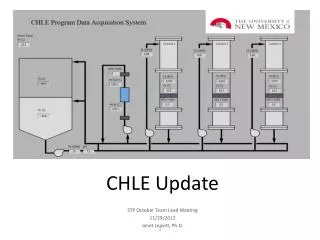
CHLE Update STP October Team Lead Meeting 11/29/2012 Janet Leavitt, Ph.D.
Overview • T2 LBLOCA Results • Bench Top Experiments • NRC Call
T2 LBLOCA • Objective • Determine the mass of aluminum corrosion • Evaluate possible effects of key corrosion and dissolution materials on head loss • Conditions • 15” Temperature profile • 6.5 hr spray • Standard Chemistry • Boric Acid, LiOH, TSP, HCL, HNO3 • Multiple Materials • Submerged zinc granules determined from 371 lbs of paint chips • Vapor and submerged STP aluminum scaffolding (90%/10%) • Submerged Fiber glass – columns and tank (41%/59%) • Submerged concrete
T2 LBLOCA Preliminary Results • SEM • Membranes • Scale • Coupons • ICP Analysis of Scale • XRD • XPS Temperature Profile Approach Velocity Differential Pressure pH Turbidity Select metal concentrations
Vapor Space Materials Pre-test Post-test
Submerged Materials • Pre-test Pre-test Post-test
Submerged Material Pre-test Post-test
XRD of Scale • Crystalline • Mixture • Main phase – Zn3(PO4)2●4H2O (Hopeite) • Trace phase – CaAl2Si7O18 ● 6H2O (Heulandite)
Scale on Submerged Al • Preliminary SEM results • Similar to constituents of MBLOCA scale • Aluminum and oxygen • Aluminum, phosphorous, and oxygen • Exception; trace amounts of zinc detected • Possibly more scale MBLOCA LBLOCA
Awaiting…. • Post-test analysis of bed • XPS Results • Another confirmation of scale constituents • Provides stoichiometric formula
SEM Captured Particle Scale
T2 Observations • Visible chemical product were detected • Measured aluminum concentrations are ~1/3 of that detected in T1 • The filtered concentrations of zinc, aluminum and calcium maybe lower than the total concentration • Membrane filters appears to capture more debris as compared to T1 • Turbidity has decreased to the lowest levels observed during the testing series • NEI beds in C2 and C3 measure head loss due to solution constituents • Chemical products may mainly be a zinc phosphate with trace amounts of aluminum and/or calcium products
Bench Top Experiments • Batch Corrosion test • Three temperatures (85, 60, 35 oC) • Three solution pH values (6.0, 7.2, 7.7) • Two time frames (24 hours and 30 days) • Aluminum only, aluminum and silicon, zinc only • Batch Dissolution/leaching test • Fiberglass dissolution in the presence of soluble aluminum • Three temperatures, pH values and two time frames • Concrete leaching test for UNM and Southern concrete samples • Path forward • Test plan will be re-visited after evaluation of current test result • More bench test for corrosion focused on zinc and aluminum materials • Another integrated tank test with blender bed
NRC Call • Kerry to discuss UNM position • UNM’s position is supported by four test • Basis for Conclusion • The release of corroded aluminum into solution is much less than predicted • Precipitation in the bulk solution is not likely to have occurred • If precipitates were to form, they would be unlikely to cause a significant increase in head loss • Conclusion • Chemical precipitates are expected to have no effect on the ECCS strainers at the STP plant for all LOCAs smaller than a 6-inch break • Likely valid for breaks up to 15 inches
Lab Tests Short Term Tank Test 30 Day Tank Tests Series 100: Leaching (concrete, debris) Series 200: Al corrosion T> 85 C Series 2000 -3000: Corrosion Test Max 30 day and initial release , variability Series 4000: Precipitation test Identification, characterization, variability Test 1 : Shake down Test 2: LBLOCA Test 1: Bed thickness to particulate Ratio 1 Test 2: Bed thickness to particulate Ratio 3 Test 2: Bed thickness to particulate Ratio 2 Test 4: MBLOCA Test 3: SBLOCA Thermodynamic Modeling Head Loss Calculator Precipitate calculator CASA