Maximizing State Funding for Career and Technical Education Programs
320 likes | 413 Vues
Explore strategies to secure and manage state funding for CTE programs effectively, covering maintenance of effort, program allocation, and teacher qualifications.


Maximizing State Funding for Career and Technical Education Programs
E N D
Presentation Transcript
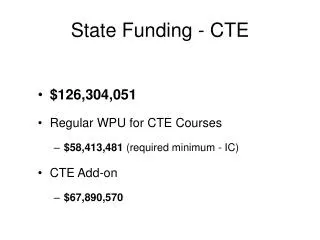
State Funding - CTE • $126,304,051 • Regular WPU for CTE Courses • $58,413,481 (required minimum - IC) • CTE Add-on • $67,890,570
State Funding - CTE • Maintenance of Effort (Regular WPU) • WPU Value $2,514 • Ongoing CTE Allocation (Add on) • WPU Value $1,817 (72%) • Prorated to allocation
State Funding - CTE • Summer Agriculture • Comprehensive Guidance • Work-Based Learning • CTE Introduction • CTE Student Leadership Organizations • Skill Certification (Competency) • ADM funded Programs (AG, BE, FACS, HO, IT, ME, TE, TI) • Administration
State Funding – Summer Ag • $.1.114 Million Allocated • Grades 9-12 • 7 WPUs for 35 students for 9 weeks • Teachers cannot work during Summer
State Funding – Comp Guid • $8.570 million allocated • Oct 1 7-12 Enrollment in approved schools • Partial Local Match Required • Application Required
State Funding – WBL • $1.406 million allocated • 50/50 local match required • Application Required
State Funding – CTE Intro • $1.056 Million Appropriated • Mainly for Equipment • Base + Prior year Oct 1 7th grade enrollment in approved schools • Application Required
State Funding - CTSO • $.485 Million Allocated • Based on number of “affiliated” members • $.385 Million Statewide Management & National Convention Expenses • $.1 Million Retained by Districts
Skill Certification • $5.644 Million allocated • For students who pass skills tests • Allocated by program based on relative membership
State Funding – Set Aside • $2.7 Million • CTE Equipment Costs • $1.9 Million Formula (Base + 5 year ave 9-12) • $.850 Million Projects (Direct Grants)
State Funding – Add-on Funds for Programs • $46.872 Million Allocated • For Added Costs of CTE programs • For 9-12 Programs • Calculated on relative membership • School Days and Periods Table • In Programs Approved by the State Board • Extra for positive growth
State Funding-CTE Administration • District WPU Verification (Annual) • Categories • District Admin 20 or 25 • Min ½ time, min 2 schools, 3 programs ea • High School Programs 10, 15, 20, 25 • # of Programs • # of Pathways • # of Courses • # of CTSOs • Technology Centers 40
WPU Verification • Changing Process from Self Report to: • PATI Approved Course Verification • CTSO Affiliated Chapter Report • Must be affiliated nationally • Periodic On-site Verifications
State Funding Sources • Ongoing CTE Allocation (Add on) • Maintenance of Effort (Regular WPU)
State Funding – Maint of Effort • 9-12 CTE ADM X WPU Value (–) Indirect Costs • Compared to CTE Expenditures from Regular WPU shown in Annual Program Report (APR) • 7-8 Grade Programs? • Tab 10 – FY 06 Illustration
Annual Program Report (APR) • 669,329 (Total Expenditures) • Add-on, Set Aside excluding TLC WBL CG • Federal • TLC (6901), WBL (6902), CG (6903) • Actual Expenditure (Column 5)
Updates to Ongoing Allocation • Ongoing Allocation • Initial Estimate – March • September Update • Mid-year Update (Jan) • Final (March) • Maintenance of Effort • Preliminary – Sept • Update – March • Final - January
Program Approval –3 StagesCraig Stoker • PATI – Annual Membership Reporting • Teacher Licensing & Assigning • Teacher/Course/Membership Reporting • State Specialist Approval • Membership Audit • Annual Report • On-site Review
Teacher Qualifications (CACTUS) • CACTUS – by Nov 15th • Licensed to Teach • Secondary Education • CTE Program Specific • Endorsement • Assignment
Teacher, Course, Membership (PATI) • (Program Approval for Technical Instruction) • School • Reporting School • Taught School (ATC, College?) • Teacher – CACTUS Links • Course (Approved CIP Code) • Enrollment • Membership (9-12 or 7-8) • PATI Reports
Reporting Issues • Jeff McDonald • jeffrey.mcdonal@schools.utah.gov • 538-7657)
Membership Audits • Teacher Roll Books • Teacher Name, CIP, Course, Term, Period, Grade • List of Coding used (including Local Board definition of unexcused absence) • Entry and exit dates • Membership and attendance summarized at the end of each course by student and course • 10 day Rule • Teacher’s signature
Membership Audits - Common Errors • 10 Day Rule • No Teacher’s Signature • Missing information (CIP Code, Course title, grade, etc.) • Double entry of students • Course information in PATI incorrect • Block Schedules vs year end reporting
Audit Issues • Making sure PATI Reports are Accurate • Compare Educator Listing to Printed Rolls • Verify School Days Table in Relation to Local SIS Membership Calculation for Upload (Critical for A/B Schedules) • Making sure Rollbooks reflect actual membership • Print Rolls After all Teacher Changes • Encourage Teachers to Identify Discrepancies in Rolls
Program Approval –3 Stages • PATI – Annual Membership Reporting • Teacher Licensing & Assigning • Teacher/Course/Membership Reporting • State Specialist Approval • Annual Report • On-site Review
Program Approval - Annual Report Process • Notice to teachers • Teacher enters evaluation data • Completed by October 15th • Report to CTE Directors of missing reports • Follow up to get all reports • Summary Report from USOE • Follow up with schools as needed
Program Approval –3 Stages • PATI – Annual Membership Reporting • Teacher Licensing & Assigning • Teacher/Course/Membership Reporting • State Specialist Approval • Annual Report • On-site Review
Program Approval - On-Site Review Process • 6-Year Cycle • Communication with School • Letter to Principal from USOE • Explanation by CTE Director or Coord • Evaluation • Instructor Self Evaluation • State Specialist On-Site Evaluation • Civil Rights Team On-Site Evaluation (if applicable) • Feedback/Improvement • Summary Report • Improvement Plan • Continuous Improvement and Follow Up