Understanding Ecosystem Relationships and Energy Flow: Trophic Structures and Human Impact
This lecture focuses on the intricate relationships within ecosystems, particularly through trophic structures and levels. Key topics include primary producers (autotrophs), consumers (herbivores and carnivores), and detritivores, along with food chains and food webs. Energy flow concepts such as primary productivity (GPP, NPP), ecological efficiency, and pyramids of productivity, biomass, and numbers are explored. Additionally, the lecture addresses human impacts on ecosystems, including biological magnification, greenhouse effects, ozone depletion, and rainforest destruction.

Understanding Ecosystem Relationships and Energy Flow: Trophic Structures and Human Impact
E N D
Presentation Transcript
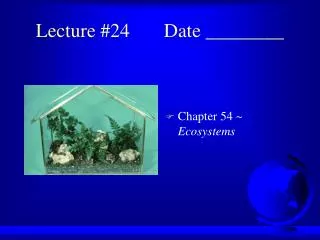
Lecture #24 Date ________ • Chapter 54 ~ Ecosystems
Relationships, I • Trophic structure / levels~ feeding relationships in an ecosystem • Primary producers~ the trophic level that supports all others; autotrophs • Primary consumers~ herbivores • Secondary and tertiary consumers~ carnivores • Detrivores/detritus~ special consumers that derive nutrition from non-living organic matter • Food chain~ trophic level food pathway
Relationships, II • Food webs~ interconnected feeding relationship in an ecosystem
Energy Flow, I • Primary productivity (amount of light energy converted to chemical energy by autotrophs) •Gross (GPP): total energy •Net (NPP): represents the storage of energy available to consumers •Rs: respiration • NPP = GPP - Rs • Biomass: primary productivity reflected as dry weight of organic material • Secondary productivity: the rate at which an ecosystem's consumers convert chemical energy of the food they eat into their own new biomass
Energy Flow, II • Ecological efficiency: % of E transferred from one trophic level to the next (5-20%) • Pyramid of productivity: multiplicative loss of energy in trophic levels • Biomass pyramid: trophic representation of biomass in ecosystems • Pyramid of numbers: trophic representation of the number of organisms in an ecosystem
Chemical Cycling • Biogeochemical cycles: the various nutrient circuits, which involve both abiotic and biotic components of an ecosystem • Water • Carbon • Nitrogen • Phosphorus
Human Impact • Biological magnification: trophic process in which retained substances become more concentrated at higher levels • Greenhouse effect: warming of planet due to atmospheric accumulation of carbon dioxide • Ozone depletion: effect of chlorofluorocarbons (CFC’s) released into the atmosphere • Rainforest destruction • Cause: Overpopulation?