Understanding Ionic, Covalent, and Metallic Bonding: Key Concepts and Naming Compounds
This comprehensive guide covers the three main types of chemical bonding: ionic, covalent, and metallic. It explores the characteristics and differences among them, demonstrating how ionic bonds involve the transfer of electrons, while covalent bonds are formed by sharing electrons. The document also offers practical techniques for naming covalent compounds using prefixes and provides rules for distinguishing between ionic and covalent substances based on electronegativity. Suitable for students and anyone interested in chemistry.

Understanding Ionic, Covalent, and Metallic Bonding: Key Concepts and Naming Compounds
E N D
Presentation Transcript
BONDING TYPES ctnd. What is covalent bonding? What is metallic bonding? How do you name or write covalent compounds?
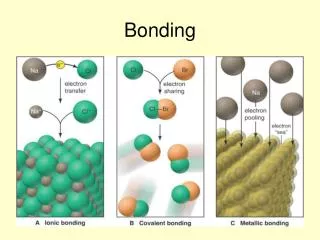
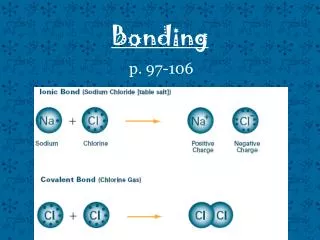
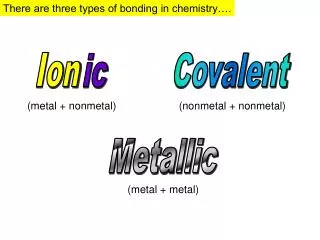
BONDING TYPES • Ionic stealing, transfer of electrons • Covalent sharing of electrons • Metallic bonds are attractions of floating valence e- to other positively charged cations (Sea of electrons, drifter) Watch Video: Common Types of Atomic Bonds http://aaronfreeman.wikispaces.com/file/view/Common_Types_of_Atomic_Bonds.mov
Ionic or Covalent? • How can I easily determine if a substance is ionic or covalent? • By calculating difference in electronegativity! • Rule of Thumb – Magic Number = 1.67 • If the difference is > 1.67 IONIC < 1.67 COVALENT = 1.67 50% Ionic and 50% Covalent
EXAMPLES • EX. Examine electronegativity between F and Cs F = 4.0 Cs = .7 |4.0 - .7| = 3.3 so …. IONIC COMPOUND Practice • Ca and Cl Ca = 1.0 Cl = 3.0 • Difference is 2.0 so Ionic Compound • S and O S = 2.5 O = 3.5 • Difference is 1 so Covalent Compound
COVALENT COMPOUNDS • Molecules neutral group of atoms held together by covalent bonds • Molecular/Covalent Compounds compound whose simplest units are molecules • Low melting/boiling points • Made from two nonmetals • EX. H2O water CO2 carbon monoxide
MOLECULAR FORMULA • Molecular Formula chemical formula of covalent cmpd • Actual number of atoms in each molecule • Does NOT tell us about arrangement of atoms • H2O : 2 atoms of H 1 atom of O • C2H6 : 2 atoms of C 6 atoms of H
NAMING MOLECULAR COMPOUNDS • DO NOT USE CHARGES!!!! • USE PREFIXES AND SUFFIXES tells how many atoms of each element are present in each molecule of the compound • How would you name? CO2 or SO3 Carbon Dioxide Sulfur Trioxide
NAMING MOLECULAR COMPOUNDS If covalent: use prefixes • OMIT the prefix mono- if the first atom is = 1 p.269 • ADD suffix to the second element of –ide • SF6 • Cl2O8 • SO3 • ICl4 • P2O5 • Carbon Tetraiodide • Phosphorus Trichloride • DinitrogenTrioxide • Br2 I2 O2 Sulfur Hexafluoride DichlorineOctoxygen …. NOT Octa-oxygen Sulfur Trioxide Iodine Tetrachloride DiphosphorusPentoxide … NOT Penta-oxide CI4 PCl3 N2O3 Oxygen Bromine Iodine