Download
1 / 9
90 likes | 220 Vues
This educational resource designed for students in Mrs. Harvey's chemistry class explores different bonding types through various compound examples. Students are tasked with identifying the first and last elements in selected compounds across three groups: ionic, covalent, and metallic. By analyzing the positions of these elements on the periodic table, students will classify them as metals or non-metals. The activity fosters a deeper understanding of chemical bonding and element characteristics, laying the groundwork for further studies in chemistry.

E N D
Types of Bonding Chemistry Mrs. Harvey
For each compound below, find the first and last element on the periodic table. • NaCl Fe2O3 • LiBr Al2S3 • KF CuI2 • ZnCl2
Think about it: • What do you notice about the locations of each of the first elements? • What do you notice about the locations of the second elements in the compounds? • Would you classify these elements as metals or non-metals?
Compound Group #2: • CCl4 • P2O5 • N2O4 • NI3 • PBr3 • SeF2
Think about it: • What do you notice about the locations of each of the first elements? • What do you notice about the locations of the second elements in the compounds? • Would you classify these elements as metals or non-metals?
Compound Group #3: • Brass, an alloy of Cu and Zn • White gold, alloy of Au, Ni & Pd • Stainless steel, alloy of Fe, Cr & Ni • Pewter, an alloy of Sn and Cu • Magnesium, Mg • Sodium, Na
Think about it: • What do you notice about the locations of each of these elements? • Would you classify these elements as metals or non-metals?
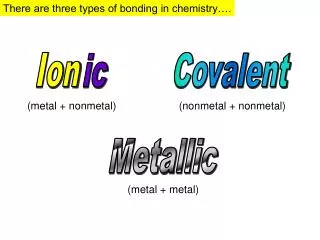
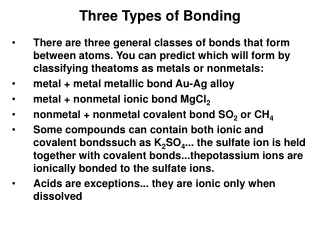
Tying it together: • Group 1 compounds are called ionic compounds • Group 2 compounds are called covalent compounds • Group 3 compounds are called metallic compounds
Now you try to classify each of the compounds below: • CoBr2 • Sterling silver, Ag and Cu • NO2 • PbCl2 • CsF • Alnico, Al, Ni and Co • OF2