Enhancing User Interaction with VR: Bridging Desktop and Virtual Interfaces
This paper explores VR as a next-generation user interface, leveraging a background in computer graphics and interactive visualization. It focuses on developing applications using the VRS scenegraph system, emphasizing the need for device-independent demonstrations. Key challenges include cognitive overload during 3D interactions and a lack of standardization. We introduce Intuitive 3D Interaction Metaphors, particularly the Improved Virtual Pointer Metaphor (IVPM), which enhances user selection without precision requirements and provides effective visual feedback. We also discuss autostereoscopic displays to create standardized, user-friendly interfaces.

Enhancing User Interaction with VR: Bridging Desktop and Virtual Interfaces
E N D
Presentation Transcript
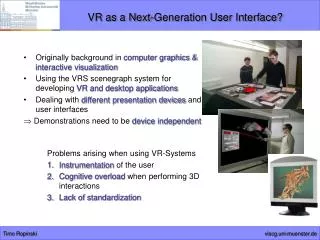
VR as a Next-Generation User Interface? • Originally background in computer graphics & interactive visualization • Using the VRS scenegraph system for developing VR and desktop applications • Dealing with different presentation devices and user interfaces Demonstrations need to be device independent Problems arising when using VR-Systems • Instrumentation of the user • Cognitive overload when performing 3D interactions • Lack of standardization
Intuitive 3D Interaction Metaphors • Virtual Pointer Metaphors • are natural and intuitive • require low effort • usable for local and remote selection • Concept of Improved Virtual Pointer Metaphor (IVPM) • afford unique selection without requirement of an exact hit • usage of adequate visual feedback about active object • different presentation
(Semi-) Next Generation UI? • Autostereoscopic Displays • Standardized UI by using the desktop metaphor • Intuitive to use through WIMP paradigm • No instrumentation of the user