Download
1 / 16
160 likes | 297 Vues
This lesson plan focuses on key mathematical concepts such as area, perimeter, and rational numbers, spanning several days of instruction. Students will engage in various activities, including calculating the area and perimeter of different shapes, understanding sets of numbers, and utilizing prime factorization to reduce fractions. The plan includes the use of tools like whiteboards, calculators, and multiplication charts, aimed at enhancing students' problem-solving skills and their understanding of greatest common factors (GCF) and equivalent fractions.

E N D
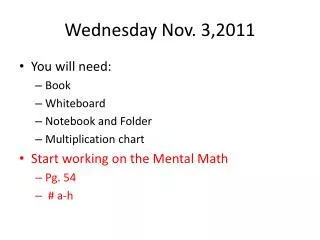
Wednesday, Nov. 9, 2011 • You will need: • Whiteboard/marker/eraser • Multiplication Chart • Folder/notebook • Calculator • Bell Ringer • A. What is the area and perimeter of a yard that is 20 ft. by 30 ft.? • B. What is the area and perimeter of this shape?
Thursda,yNov. 10, 2011 • You will need: • Math book • Folder/notebook • calculator • Bell ringer • A. What sets of numbers does the number -10 belong to? • B. What is GCF? When do we use it?
Friday, Nov. 11, 2011 • You will need: • Math book • Folder/Notebook • Whiteboard/marker/eraser • Bell Ringer • A. Use prime factorization to reduce 72/100. • B. Change 11/7 to a mixed number.
Monday, Nov. 14, 2011 • You will need: • Math book • Folder/Notes • Calculator • Bell Ringer: • A. What is the GCF of 20 and 40? • B. Create an equivalent fraction to 1/3 with a denominator of 300.
Lesson 10 Rational Numbers and Equivalent Fractions
Sets of Numbers • Counting Numbers- • Whole Numbers- • Integers- • Rational Numbers- fractions and decimals • (Show on a number line)
Equivalent Fraction • Different ways to name the same amount. • (Use fraction bars to illustrate)
Greatest Common Factor • The greatest common factor of a set of numbers is the largest whole number that is a factor of every number in the set. • We can reduce a fraction using the GCF. • Use a multiplication chart to help you find the GCF of a set of numbers.
Examples • Find the GCF of: • 12 and 15 • 24 and 12 • 30 and 10
Using Prime Factorization to Reduce • 72/108 • 50/100
Create an Equivalent Fraction • Fish hook Examples: • Write a fraction equivalent to ½ that has a denominator of 100. • ¾ that has a denominator of 12. • 5/6 with a denominator of 24.
Comparing Fractions • Change to a decimal • 2/3 and 3/5 • ¼ and 2/8 • 3/10 and 5/6
Improper Fractions • Improper- 7/2, 4/4, 10/3, 12/6 • Not Improper- 2/5, 1/8, 3/10, 6/12
Mixed Numbers • A whole number and fraction • 2 ¾ • 1 ¼ • 4 ½
Changing Improper to Mixed • (use fraction blocks) • 5/2 • 6/3 • 4/4