SlideServe
Menu
Préférences
© SlideServe · v2026

Artificial Intelligence in the US Military

zulema avatar
7 diapositives · 829 Views · Jan 30, 2013

Artificial Intelligence in the US Military. Images from wiredforwar.pwsinger.com.

Artificial Intelligence in the US Military - slide 1
01 / 7Artificial Intelligence in the US Military
1 / 17

Télécharger la présentation

Artificial Intelligence in the US Military
Une image / un lien ci-dessous est fourni (tel quel) pour télécharger la présentation

Politique de téléchargement : le contenu du site vous est fourni TEL QUEL pour votre information et votre usage personnel ; il ne peut être vendu, concédé sous licence ni partagé sur d’autres sites sans l’accord de son auteur.Le contenu vous est fourni TEL QUEL, pour votre information et votre usage personnel uniquement. Téléchargez la présentation en cliquant sur ce lien. Lors du téléchargement, si vous ne parvenez pas à télécharger une présentation, l’éditeur a peut-être supprimé le fichier de son serveur.Pendant le téléchargement, si vous ne parvenez pas à obtenir une présentation, le fichier a peut-être été supprimé par l’éditeur.

F I N

Plus de contenu associé

Transcription de la présentation
  1. Artificial Intelligence in the US Military Images from wiredforwar.pwsinger.com

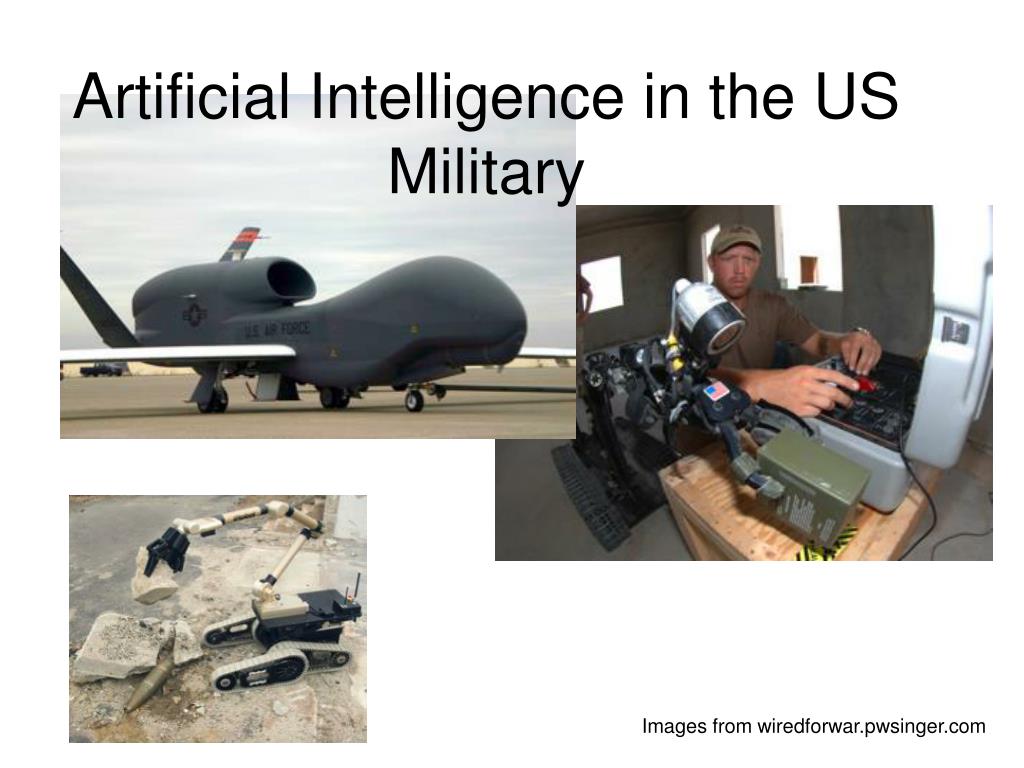
  2. It sounds like science fiction, but it is fact: On the battlefields of Iraq and Afghanistan, robots are killing America’s enemies and saving American lives. But today’s Pack Bots, Predators, and Ravens are relatively primitive machines. The coming generation of “war-bots” will be immensely more sophisticated, and their development raises troubling new questions about how and when we wage war.

  3. Strong vs. Weak AI • Strong AI: “Artificial intelligence that matches or surpasses human intelligence.” • Must be able to: • Reason • Plan • Learn • Communicate • Integrate this skills towards common goals • Weak AI: “Use of software to study and accomplish specific problem solving or reasoning tasks not encompassing full range of human cognitive abilities.” • How it’s being done: the Blue Brain Project. Tries to simulate the human brain using supercomputers.

  4. Packbot • The packbot is only one of many unmanned systems operating in Iraq and Afgahnistan today. • In 2003 there were no packbots in Iraq • By the end of 2008, 12,000 packbots were projected to be deployed in Iraq • These are just the 1st generation. Scientists are trying to equip potbots with automated machine guns and robotic ­stretcher

  5. Raven UAV Raven Specs: • Wing Span 4 ft 3 in • Length 3 ft 7 in • Weight 4.2 lb • Engine Aveox 27/26/7-AV electric motor • Cruising speed 60 mph • Range 6.2 miles • Endurance approx. 80 min The Raven is a remote-controlled miniature unmanned aerial vehicle (UAV). The craft is launched by hand and powered by an electric motor. (wikipedia.com)

  6. Biomimectics

  7. Juice for your Noggin • Why do you think unmanned systems have been used in greater numbers in places like Iraq and Afghanistan? Do you see this trend continuing? • Will the robotics trend make wars easier or harder to start? Why? • Will the robotics trend help or hurt America's standing in the world? How so? • What do you think will be the key legal issues to resolve in the robotics field? Questions from:wiredforwar.pwsinger.com