Download
1 / 36
360 likes | 468 Vues
This work explores the phenomenology of M-theory compactifications on G2 manifolds. It presents an overview of prior research, including calculations of soft SUSY breaking terms and mechanisms for electroweak symmetry breaking. The study discusses how moduli stabilization is achieved without flux, leading to spontaneous SUSY breaking and a potentially viable solution to the hierarchy problem. Emphasis is placed on precision gauge coupling unification and predictions relevant to LHC phenomenology, paving the way for future research directions in high-energy physics.

E N D
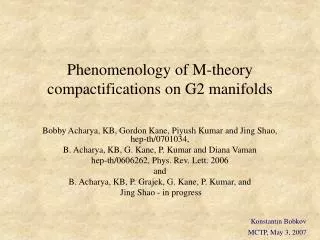
Phenomenology of M-theory compactifications on G2 manifolds Bobby Acharya, KB, Gordon Kane, Piyush Kumar and Jing Shao, hep-th/0701034, B. Acharya, KB, G. Kane, P. Kumar and Diana Vaman hep-th/0606262, Phys. Rev. Lett. 2006 and B. Acharya, KB, P. Grajek, G. Kane, P. Kumar, and Jing Shao - in progress Konstantin Bobkov MCTP, May 3, 2007
Outline • Overview and summary of previous results • Computation of soft SUSY breaking terms • Electroweak symmetry breaking • Precision gauge coupling unification • LHC phenomenology • Conclusions and future work
M-theory compactifications without flux • All moduli are stabilized by the potential generated by the strong gauge dynamics • Supersymmetry is broken spontaneously in a unique dS vacuum • is the only dimensionful input parameter. Generically ~30% of solutions give Hence – true solution to the hierarchy problem • When the tree-level CC is set to zero for generic compactifications with >100 moduli !
Overview of the model • The full non-perturbative superpotential is • where the gauge kinetic function • Introduce an effective meson field • For and hidden sector gauge groups: • , , , where SU(N): ck=N SO(2N): ck=2N-2 E8: ck=30 dual Coxeter number
An N-parameter family of Kahler potentials consistent with holonomy and known to describe accurately some explicit moduli dynamics is given by: • where the 7-dim volume • and the positive rational parameters satisfy • Beasley-Witten: hep-th/0203061, Acharya, Denef, Valandro. hep-th/0502060 after we add charged matter
Moduli Stabilization (dS) • When there exists a dS minimum if the following condition is satisfied, i.e. • with moduli vevs • with meson vev
Moduli vevs and the SUGRA regime from threshold corrections Since ai~1/N we need to have large enough in order to remain in the SUGRA regime • Friedmann-Witten: hep-th/0211269 integers For SU(5): ,where can be made large O(10-100) dual Coxeter numbers
When there exists a dS minimum with a tiny CC if the following condition is satisfied, i.e. • moduli vevs • meson vev
Recall that the gravitino mass is given by • where • Take the minimal possible value and tune . .Then • Scale of gaugino condensation is completely fixed!
Computation of soft SUSY breaking terms • Since we stabilized all the moduli explicitly, we can compute all terms in the soft-breaking lagrangian Nilles: Phys. Rept. 110 (1984) 1, Brignole et.al.: hep-th/9707209 • Tree-level gaugino masses. Assume SU(5) SUSY GUT broken to MSSM. • where the SM gauge kinetic function
Tree-level gaugino masses for dS vacua • The tree-level gaugino mass is always suppressed for the entire class of dS vacua obtained in our model • The suppression factor becomes completely fixed! - very robust
Anomaly mediated gaugino masses • Lift the Type IIA result to M-theory. Yields flavor universal scalar masses • Bertolini et. al.: hep-th/0512067 Gaillard et. al.: hep-th/09905122, Bagger et. al.: hep-th/9911029 where - constants - rational
Anomaly mediated gaugino masses. If we require zero CC at tree-level and : • Assume SU(5) SUSY GUT broken to MSSM • Tree-level and anomaly contributions are almost the same size but opposite sign. Hence, we get large cancellations, especially when - surprise!
Recall that the distribution peaked at O(100) TeV • Hence, the gauginos are in the range O(0.1-1) TeV • Gluinos are always relatively light – general prediction of these compactifications! • Wino LSP
Trilinear couplings. If we require zero CC at tree-level and : • Hence, typically
Scalar masses. Universal because the lifted Type IIA matter Kahler metric we used is diagonal. If we require zero CC at tree-level and : • Universal heavy scalars
in superpotential from Kahler potential. (Guidice-Masiero) • - problem • Witten argued for his embeddings that -parameter can vanish if there is a discrete symmetry • If the Higgs bilinear coefficient then typically expect • Phase of - interesting, we can study it physical
Electroweak Symmetry Breaking • In most models REWSB is accommodated but not predicted, i.e. one picks and then finds , which give the experimental value of • We can do better with almost no experimental constraints: • since , • Generate REWSB robustly for “natural” values of , from theory
Prediction of alone depends on precise values of • and • Generic value • Fine tuning – Little Hierarchy Problem • Since , the Higgs cannot be too heavy M3/2=35TeV 1 < Zeff < 1.65
PRECISION GAUGE UNIFICATION • Threshold corrections to gauge couplings from KK modes (these are constants) and heavy Higgs triplets are computable. • Can compute Munif at which couplings unify, in terms of Mcompact and thresholds, which in turn depend on microscopic parameters. • Phenomenologically allowed values – put constraints on microscopic parameters. • The SU(5) Model – checked that it is consistent with precision gauge unification.
Details: • Here, big cancellation between the tree-level and anomaly contributions to gaugino masses, so get large sensitivity on • Gaugino masses depend on , BUT in turn depends on corrections to gauge couplings from low scale superpartner thresholds, so feedback. • Squarks and sleptons in complete multiplets so do not affect unification, but higgs, higgsinos, and gauginos do – μ, large so unification depends mostly on M3/M2 (not like split susy) • For SU(5) if higgs triplets lighter than Munif their threshold contributions make unification harder, so assume triplets as heavy as unification scale. • Scan parameter space of and threshold corrections, find good region for in full two-loop analysis, for reasonable range of threshold corrections.
α1-1 α2-1 α3-1 t = log10 (Q/1GeV) Two loop precision gauge unification for the SU(5) model
M3 M2 M1 After RG evolution, can plot M1, M2, M3 at low scale as a function of for ( here )
M3 M2 M1 Can also plot M1, M2, M3 at low scale as a function of In both plots as
Moduli masses: • one is heavy • N-1 are light • Meson is mixed with the heavy modulus • Since , probably no moduli or gravitino problem • Scalars are heavy, hence FCNC are suppressed
LHC phenomenology • Relatively light gluino and very heavy squarks and sleptons • Significant gluino pair production– easily see them at LHC. • Gluino decays are charge symmetric, hence we predict a very small charge asymmetry in the number of events with one or two leptons and # of jets • In well understood mechanisms of moduli stabilization in Type IIB such as KKLT and “Large Volume” the squarks are lighter and the up-type squark pair production and the squark-gluino production are dominant. Hence the large charge asymmetry is preserved all the way down
Example For , get Compute physical masses: Dominant production modes: (s-channel gluon exchange) (s-channel exchange) (s-channel exchange) almost degenerate!
Decay modes: ~37% ; ~ 50% ; ~20.7% ; ~ 50% ; ~19% ; ~8.3% ; ~12% ; very soft! ~3% ; is quasi-stable!
Signatures • Lots of tops and bottoms. • Estimated fraction of events (inclusive): • 4 tops 14% • same sign tops 23% • same sign bottoms 29% • Observable # of events with the same sign dileptons and trileptons. Simulated with 5fb-1 using Pythia/PGS with L2 trigger (tried 100,198 events; 8,448 passed the trigger; L2 trigger is used to reduce the SM background) • Same sign dileptons 172 • Trileptons 112
After L2 cuts Before L2 cuts L2 cut Before L2 cuts After L2 cuts
Dark Matter • LSP is Wino-like when the CC is tuned • LSPs annihilate very efficiently so can’t generate enough thermal relic density • Moduli and gravitino are heavy enough not to spoil the BBN. They can potentially be used to generate enough non-thermal relic density. • Moduli and gravitinos primarily decay into gauginos and gauge bosons • Have computed the couplings and decay widths • For naïve estimates the relic density is too large
Phases • In the superpotential: • Minimizing with respect to the axions ti and • fixes • Gaugino masses as well as normalized trilinears have the same phase given by • Another possible phase comes from the Higgs bilinear, generating the - term • Each Yukawa has a phase
Conclusions • All moduli are stabilized by the potential generated by the strong gauge dynamics • Supersymmetry is broken spontaneously in a unique dS vacuum • Derive from CC=0 • Gauge coupling unification and REWSB are generic • Obtain => the Higgs cannot be heavy • Distinct spectrum: light gauginos and heavy scalars • Wino LSP for CC=0, DM is non-thermal • Relatively light gluino – easily seen at the LHC • Quasi-stable lightest chargino – hard track, probably won’t reach the muon detector
Our Future Work • Understand better the Kahler potential and the assumptions we made about its form • Compute the threshold corrections explicitly and demonstrate that the CC can be discretely tuned • Our axions are massless, must be fixed by the instanton corrections. Axions in this class of vacua may be candidates for quintessence • Weak and strong CP violation • Dark matter, Baryogenesis, Inflation • Flavor, Yukawa couplings and neutrino masses