
SlideServe
Menu
Préférences
© SlideServe · v2026

Phenomenology

shana avatar
22 diapositives · 798 Views · Aug 24, 2014

Phenomenology. Readings: Theory Text Ch. 6, Introduction,6:1, 6:5. Phenomenology (as a study of relations between appearances, perception, experience & knowledge). Phenomenology (in philosophy) Objective experience (shared things that are objectively true)
Phenomenology - slide 1
01 / 22Phenomenology
1 / 17

Télécharger la présentation

Phenomenology
Une image / un lien ci-dessous est fourni (tel quel) pour télécharger la présentation

Politique de téléchargement : le contenu du site vous est fourni TEL QUEL pour votre information et votre usage personnel ; il ne peut être vendu, concédé sous licence ni partagé sur d’autres sites sans l’accord de son auteur.Le contenu vous est fourni TEL QUEL, pour votre information et votre usage personnel uniquement. Téléchargez la présentation en cliquant sur ce lien. Lors du téléchargement, si vous ne parvenez pas à télécharger une présentation, l’éditeur a peut-être supprimé le fichier de son serveur.Pendant le téléchargement, si vous ne parvenez pas à obtenir une présentation, le fichier a peut-être été supprimé par l’éditeur.

F I N

Plus de contenu associé

Transcription de la présentation
  1. Phenomenology Readings: Theory Text Ch. 6, Introduction,6:1, 6:5

  2. Phenomenology (as a study of relations between appearances, perception, experience & knowledge) • Phenomenology (in philosophy) • Objective experience (shared things that are objectively true) • Despite the fact that we all perceive things differently • Because of self-consciousness it is possible to get at an understanding of what “appears to be” that can be shared with others (and is common or trues) • Everything is not just an illusion or is subjectively experienced • In Philosophy there are technical arguments for how this happens • Key notions: exploring connections between • appearances, self-consciousness, experience and reality • Attempt to get away from notion that what you see is only in your mind • Used in a wide variety of ways, often to discredit psychological interpretations of tensions between individual perception and notions of to possibility of understanding relationship between appearances and “truth” or “reality” that can be communicated

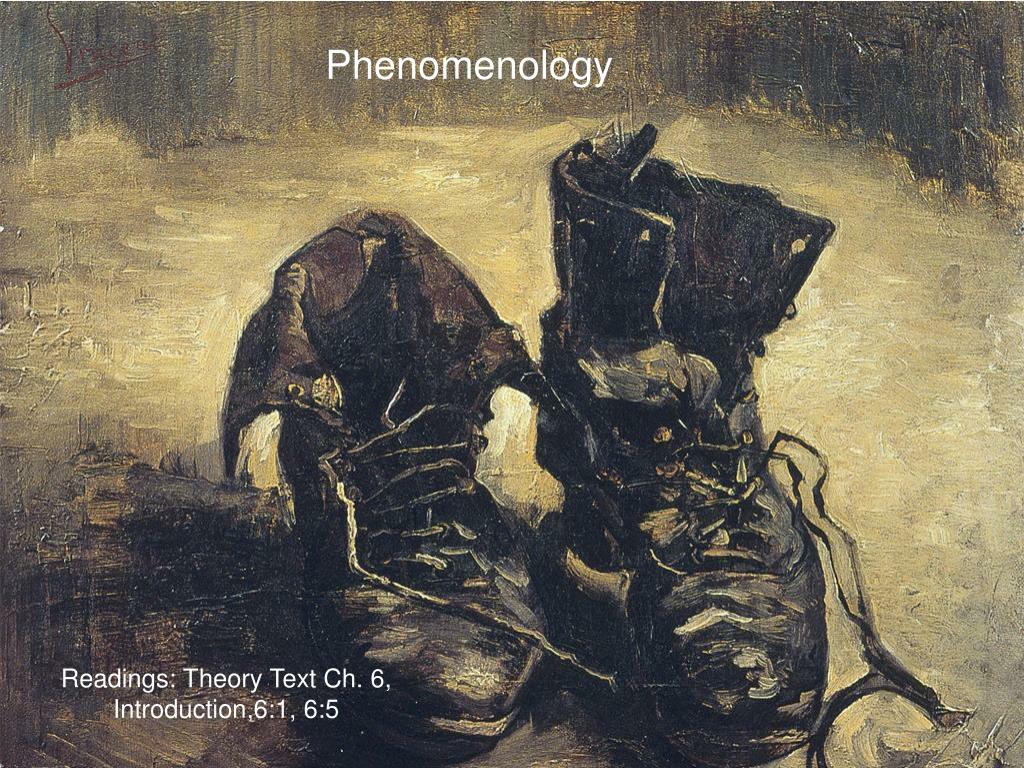
  3. Martin Heidegger: Thing & Work • Essence of visual art : discovering the “truth of beings setting itself to work” • Ways of conceiving of the “un-concealment” of being through visual images • Vincent Van Gogh A Pair of Shoes 1883.

  4. What do shoes consist of? What are their uses?

  5. Shoes in General /Image of Empty unused shoes but with traces of use

  6. How do shoes serve as equipment for doing/experincing? Whose world(s)?

  7. Experiencing world of the peasant women through theimage of her worn shoes

  8. What is the essence of the “Being” revelaed through the experience of viewing the image of the shoes? • Work of art (or visualization) not a reproduction of a particular being but a way of getting at a more general “essence” through experience of appearances that are not only in individual minds but connected in deep ways to varieties of experience that can be shared

  9. Don Ihde: Scientific Visualism • not just a way of seeing • Anticipated discoveries that could not been seen with technologies of the past • Scientific “seeing” not just visual • multidimensional • Synesthetic (involves more than one of the senses) • also a hermeneutic (interpretative, meaning-making) practice Leonaro Da Vinci (examples of anatomical drawing and flying machine)

  10. Modes of Scientific Visualization • Translation (transforming non-visual dimensions into visual ones like these population growth graphs) • Isomorphic (reproducing visual elements, such as anatomical drawings) Estimated population growth from 10000 BCE–2000 CE Past and projected population growth on different continents. The vertical axis is logarithmic and its scale is millions of people.

  11. Gestalt Features • Interaction of “visual intentionality” with visual displays • Constituted by context and field of significations • Ex. figure-ground observations

  12. Arcimboldii

  13. Gilbert

  14. Gestalt -emergence

  15. More Figure-Ground Examples

  16. “Trompe-l’oeil” • “Fool the Eye” • Often used to describe the effects of painting that gives the impression of being the things they represent (in decorative arts too-- for example painting wood to look like marble)

  17. Ingres

  18. Ingres (detail)

  19. Audrey Flacke Chanel (acrylic on canvas)

  20. Other Images Referred to in the Readings for this week • Prehistoric cave paintings in Lascaux (France)

  21. Lascaux

  22. Cindy Sherman