Inner vs. Outer Planets: A Comparative Study
Explore the differences between inner terrestrial planets and outer jovian planets in our solar system. Learn about their composition, moons, rings, distances from the sun, sizes, and orbital characteristics. Discover why Pluto is classified differently.

Inner vs. Outer Planets: A Comparative Study
E N D
Presentation Transcript
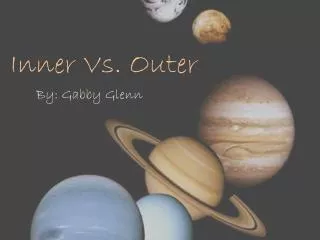
Inner Vs. Outer By: Gabby Glenn
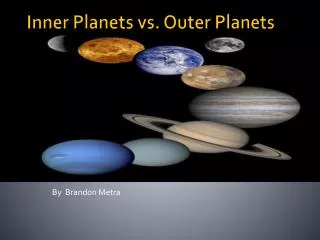
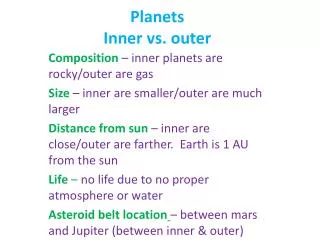
Inner Planets Terrestrial Planets: Mercury, Venus, Earth, and Mars • Composed mostly of rock and heavy metal • Have few or no moons • No rings • Average 58-228 million km from the sun • Small and dense • Rotation periods range from .99 to 243 days • Revolution periods range from 87.97 days to 1.88 years • Diameters range from 4,878 to 12,756 km
Outer Planets Jovian Planets: Jupiter, Saturn, Uranus and Neptune • Are Gaseous with liquid cores • Dozens of moons • Rings made out of ice and rock • Averages 778.5million- 4.5 billion km from the sun • Rotation period ranges from .41 to 6.39 days • Revolution periods range from 11.86 to 248.59 years • Diameters range from 48,600 to 142,800 km
Pluto • A planet must orbit around the sun, have sufficient mass for its self gravity to make a sphere shape, and it must clear its neighborhood around its orbit. • Pluto has not cleared its neighborhood.