Unveiling Divine Inspiration: Approaches to Scripture Interpretation
Explore fundamental, rational, and contextual approaches to interpreting the Word of God, using starter questions and classical perspectives for deeper understanding. Delve into key documents like Divino Afflante Spiritu and Dei Verbum for guidance on utilizing modern methods.

Unveiling Divine Inspiration: Approaches to Scripture Interpretation
E N D
Presentation Transcript
Scripture Interpretation The Word of God
How does Divine inspiration relate? • Dictated word-for-word? Fundamental approach • Guidance to human authors? Contextual approach • Holy Spirit not active Rationalist approach
Fundamental Approach Does not take into account historical setting or teaching Plain reading of Scripture
Rational Approach A reasoned scientific analysis
Contextual Approach • Investigate from various perspectives
Why starter questions? • Know what to expect • Helps prepare to search deeper • Helps apply messageto self appropriately • Preparation to put Scripture into action
What are the starter questions? • Who is the author? • Who is the intended audience? • What is the time period? • What type of writing is it? • What is its main purpose?
4 Classical Perspectives ‘Literal’ Sense Allegorical Sense Moral Sense Anagogical Sense
Magisterium Definition? Role?
DivinoAfflanteSpiritu • http://www.vatican.va/holy_father/pius_xii/encyclicals/documents/hf_p-xii_enc_30091943_divino-afflante-spiritu_en.html • “Inspired by the Divine Spirit” • 1943 Encyclical • Permitted limited use of modern methods of Biblical criticism
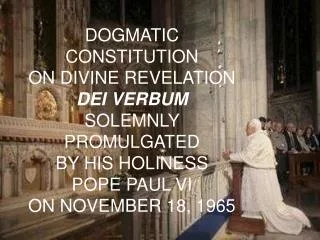
Dei Verbum • http://www.vatican.va/archive/hist_councils/ii_vatican_council/documents/vat-ii_const_19651118_dei-verbum_en.html • “Word of God” • Dogmatic Constitution on Divine Revelation • 1965 Vatican II = Conciliar document • Further explored use of literary techniques
Interpretation of the Bible in the Church • Pontifical Biblical Commission • Offered several techniques for interpretation
Analogy of Faith • Unity in all Church teaching • Unity of teaching of entire Bible • Means both Old & New
Redact • Editing of sacred stories • Authors arranged & shaped • To help audience understand