BASICS OF SEQUENCE ALIGNMENT
BASICS OF SEQUENCE ALIGNMENT

BASICS OF SEQUENCE ALIGNMENT
E N D
Presentation Transcript
BASICS OF SEQUENCE ALIGNMENT Submitted by: Anish and Pankaj M.Sc. Systems Biology & Bioinformatics Panjab University, Chandigarh
INTRODUCTION A sequence alignment is the way of arranging sequences like DNA, RNA and protein to identify similarities like functional, structural evolutionary between sequences • Sequence alignment should be between known and unknown sequence or between two unknown sequences. • Here, known sequence will be called as reference sequence and known sequence will be called query sequence. Types of sequence alignment Local Alignment Global Alignment
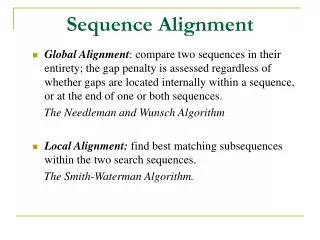
GLOBAL ALIGNMENT Based on Needleman-Wunsch algorithm In global alignment, Two sequences to be aligned which are assumed to be similar over entire length. Where, the alignment is done from beginning to the end of both the sequences to find best possible alignment. Input: Two sequences as potentially equivalent. Goal: To identify the similarity and dissimilarity.
LOCALALIGNMENT Its based on Smith-Waterman algorithm. Its only find local regions with highest similarity level between two sequences and aligns the regions without assuming that these two sequences have any similarity for entire length. Input: Two sequences may or may not be similar. Goal: Will see substring of one sequence aligns well with the other.
APPLICATIONS Global Alignment Local Alignment To compare two genes with similar function. To compare two proteins with similar function. To search the local similarities in large sequences To look for the conserved domains or the motifs in two proteins
REFERENCE Xiong, J. (2006). Pairwise Sequence Alignment. In Essential Bioinformatics (pp. 31-50). Cambridge: Cambridge University Press. doi:10.1017/CBO9780511806087.004