three phase
E N D
Presentation Transcript
Three Phase Systems AC generation on aircraft is a three phase system • In (a) the single phase generator has one rotating coil (wound many times). One cable going to the consumer units. • In (b) there are two coils on the same armature at 90° to each other and there would be two cables going to the consumer units. • In (c) there are three coils on the same armature at 120° to each other producing three outputs at 120° phase difference. Three supply cables would be used - one for each phase, each going to its own bus on the aircraft. • The phases is usually connected together either a STAR () configuration or DELTA () configuration.
Three Phase Systems (cont’d) Star Connected Generator • Each winding is connected to a common point called the NEUTRAL or STAR point. The three LINES are taken from the start of each phase winding LINE Current and PHASE Current are the same , IL = Iph • LINE Voltage is derived from the two phases that are connected across each pair of lines. Because the phase voltages are 120° out of phase with each other, the LINE voltage is found by multiplying the PHASE Voltage by √3, • VL = √3 x Vph
Three Phase Systems (cont’d) Delta Connected Generator • LINE voltage (VL) and PHASE voltage (Vph) is the same (VL = Vph) • LINE current is derived from the currents that are flowing in the two windings that are connected to that particular line. As the phases are 120° out-of-phase with each other the LINE current (IL) is found by multiplying PHASE current (Iph) by √3 , • IL = √3 Iph
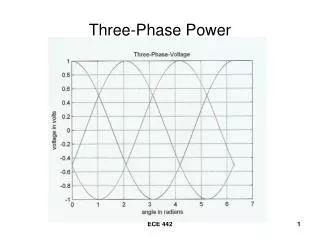
Three Phase Systems (cont’d) Three Phase Voltages • As the output windings of the generator are identical, their outputs will be winding of equal amplitude. These outputs are represented both graphically and as phasors • If the values above zero are called ‘+’ and those below zero are called ‘-‘, the sum of the voltages at any instant in time is always zero.
Three Phase Systems (cont’d) A Symmetrical Three-Phase System • The phase voltages are of the same magnitude and of the same phase displacement. • The phase currents may have differ magnitudes and phase displacements, depending upon the type and magnitude of the phase loads.
Three Phase Systems (cont’d) Balanced Three-Phase System • The phase loads are equal and, therefore, the phase currents are equal in magnitude and are operating at the same phase angle. • The sum of the instantaneous currents (a current at an instant in time) in a BALANCED system always equals zero.
Three Phase Systems (cont’d) The relationships Between LINE and PHASE Voltages • If the instantaneous values of two phases (say, A and B) are added together, the result will be a third waveform (line AB). • To do this with phasors, it is necessary to reverse one of the two (say B) and then add the two phasors. • If this process is repeated in the same order for the other two pairs of phases, the result will be as shown.
Three Phase Systems (cont’d) Power in a Balanced Three-Phase System • In the Star and Delta connected loads, the True Power in each phase is given by: P = VphIphcos Ø Watts • In a symmetrical and balanced system, the True Power is given by the sum of the phase powers.: • P = 3 VphIphcos Ø Watts • It is however, usual to express True Power in terms of line values, in which case it is given by: • P = √3 VL ILcos Ø Watts